
Study · Forwarding Agents of Pre-1854 India
Thomas Waghorn & the Overland Mail
The forwarding agent who helped speed up the mail between Britain and India
By Gowtham BJ · Hand Struck Stamps of India

During the age of sail, a letter sent from London to Bombay normally travelled around the Cape of Good Hope. The voyage could take about three months, and a reply might not reach the original sender for the better part of a year.

Thomas Fletcher Waghorn believed that much of this time could be saved by carrying the mail through Egypt. Letters could travel by sea to Alexandria, cross Egypt to Suez and continue through the Red Sea towards India. The route itself was not a new idea, but making it work regularly was another matter.
Waghorn devoted much of his life to organising that connection. By the later 1830s, the words “Care of Mr Waghorn” were appearing on letters carried between Britain and India by the faster overland route.
These forwarding-agent markings are the reason Waghorn remains so familiar to postal historians. The present census records 21 distinct Waghorn markings on 234 covers, ranging from commonly encountered types to markings known from only one or two examples.
The Three-Month Problem
Before the overland service became practical, most mail between Britain and India was carried by sailing vessel around southern Africa. The journey covered thousands of miles and generally took three months or longer.
The geographical alternative was obvious. A letter could cross the Mediterranean to Egypt, travel overland between Alexandria and Suez, and then continue through the Red Sea and Indian Ocean. The difficulty lay in arranging the journey.
Transport had to be available when the mail arrived. Couriers, boats, horses and carriages had to connect with one another. Travellers needed rest houses, provisions and protection while crossing the desert. A delay at any one point could remove much of the advantage gained by avoiding the Cape.
Waghorn worked to turn this uncertain chain of connections into a functioning mail route.
The exact time varied according to ships, weather and connections, but the overland route could reduce the journey by several weeks.
Waghorn and the Work Behind the Route
Waghorn entered the Royal Navy when he was twelve. He later served with the Bengal Marine Pilot Service and took part in the First Anglo-Burmese War. By the late 1820s, he had become convinced that regular communication with India could be greatly improved by using the Egyptian route.
He retired as a lieutenant in 1832 and concentrated on the overland scheme.
The work was neither simple nor glamorous. Waghorn spent years travelling through Egypt, arranging transport, dealing with local authorities and maintaining relays across the desert. Rest houses were required along the route, as were horses, carriages, couriers and dependable connections with vessels operating on the Mediterranean and Red Sea.
He also had to contend with official resistance and commercial rivalry. Much of the system depended upon personal arrangements and constant supervision. When something failed—a vessel arrived late, animals were lost or a connection was missed—Waghorn or one of his agents had to find another way to move the mail.
In 1844, plague reportedly killed around three hundred of his horses. By this time, the government-supported Peninsular and Oriental Steam Navigation Company was taking an increasingly important role in carrying the mails. A private forwarding agent could not compete indefinitely with a company holding official contracts.
Waghorn continued trying to reduce journey times, including by arranging faster connections across Europe to Marseilles. He received recognition for his work, but not the financial reward he believed was due to him. He died in London on 7 January 1850, aged forty-nine and heavily in debt.
A Life in Dates
- 1800Born on 20 June at Chatham, Kent.
- 1812Entered the Royal Navy at the age of twelve.
- 1819Joined the Bengal Marine Pilot Service.
- 1824Served during the First Anglo-Burmese War aboard the cutter Matchless. A position associated with him on the Arakan River later became known as Waghorn’s Rock.
- 1829–1830Began publicly promoting an overland mail route between Britain and India through Egypt.
- 1832Retired as a lieutenant and devoted himself to the overland project.
- 1835–1837Worked on the practical arrangements required for the Egyptian crossing, including rest houses, transport relays and connections between sea routes.
- 1837Received the support of the Pasha of Egypt and operated a forwarding business connected with Cornhill, London.
- 1836–1842The principal period during which the familiar “Care of Mr Waghorn” markings recorded in this census were used.
- 1844The loss of his horses, official competition and the increasing role of the P&O brought his independent operation close to an end.
- 1850Died in London on 7 January, aged forty-nine. He was buried at Snodland.
- 1869 · 1888His contribution was recognised after his death by monuments near Suez and at Chatham.
How a Letter Travelled
One of the covers in this census provides a particularly useful example of how the overland route operated.
The letter was written at Gowahutty—now Guwahati—in Assam in November 1839. It first travelled to Calcutta, where it was registered with Waghorn’s agent and received the “Care of Mr T. Waghorn / Suez” forwarding mark.
It was then sent across India to Bombay. From Bombay, it travelled aboard the East India Company steamer Berenice to Suez. Waghorn’s couriers carried it across Egypt to Alexandria. From there, it continued by H.M. packet Blazer to Malta and then by H.M. packet Mageara to Marseilles.
The letter reached London in January 1840 before being sent on to its final destination in Cornwall.
A single folded letter therefore passed through several postal systems and several kinds of transport: the Indian inland post, an East India Company steamer, Waghorn’s Egyptian agency, British packets in the Mediterranean and finally the British Post Office.
Not every letter followed exactly the same route. Waghorn also used the Red Sea port of Cossier—now generally known as El Qoseir—with a caravan connection across Egypt. Covers bearing the “CARE OF MR. WAGHORN / COSSIER” marking are among the rarest associated with his agency. Only two are presently recorded in this census.
Recorded Covers
The census currently contains 234 covers bearing or associated with Waghorn forwarding-agent markings. The examples below show different parts of the service and different levels of rarity.
Each entry links to the complete census record, where the route, postal markings, dates, rates and provenance can be examined in detail.

Waghorn Sidebottom 2
One of only two recordedAn 1836 folded letter from Calcutta to Glasgow bearing a bold two-line “CARE OF MR. WAGHORN / COSSIER” handstamp. The manuscript registration notation below the address may have been written by Waghorn himself.
Full record · COV-1686 →
Waghorn Sidebottom 3a
The complete route documented on one coverAn 1839 entire from Gowahutty to Cornwall, carried through Calcutta and Bombay before travelling by the overland route through Egypt. Its postal markings and endorsements allow much of the journey to be reconstructed.
Full record · COV-2153 →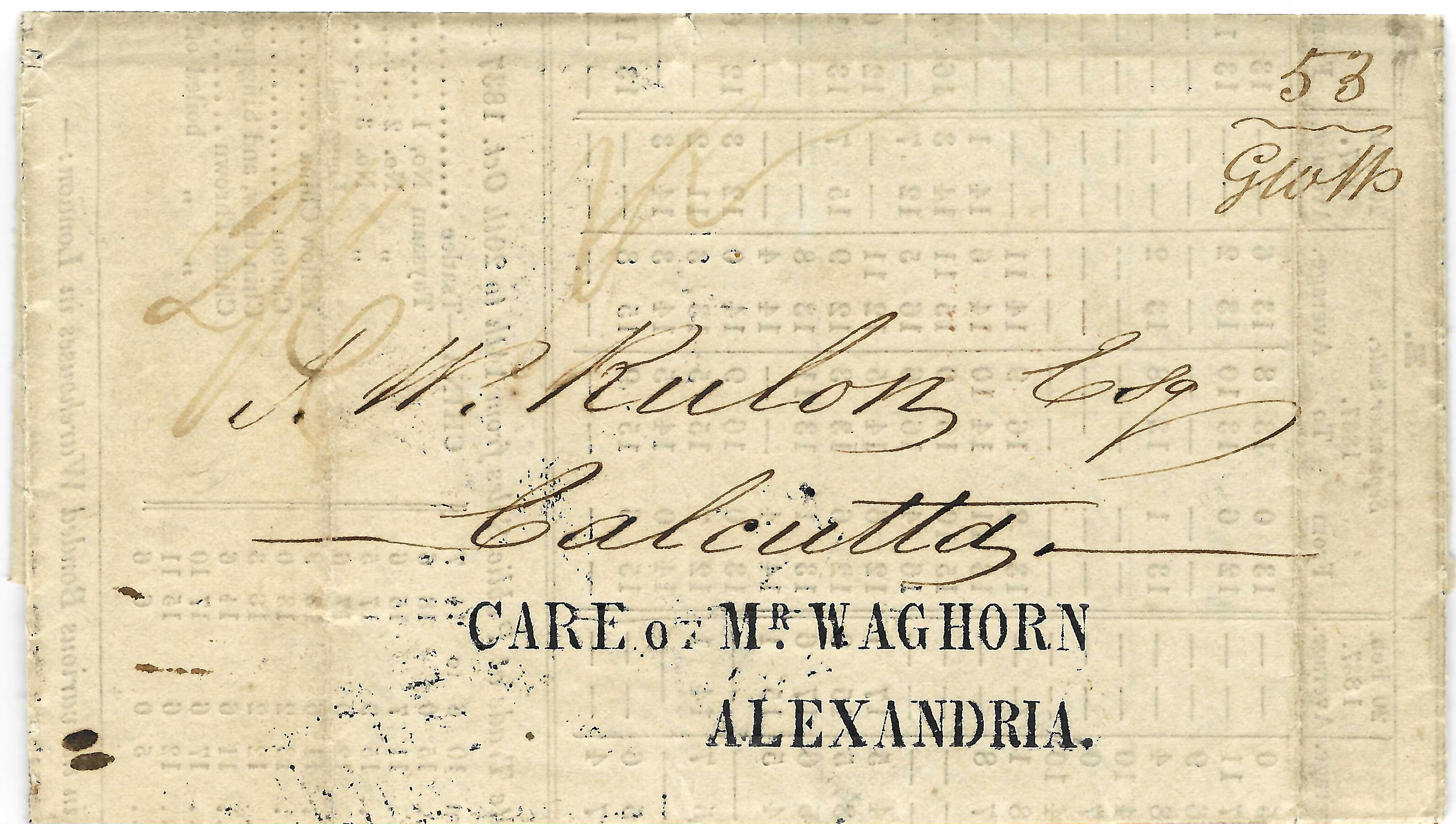
Waghorn Sidebottom 4
An inward letter to CalcuttaAn 1837 folded entire from London to Calcutta bearing the two-line “CARE OF Mr. WAGHORN / ALEXANDRIA” handstamp. It was prepaid to Alexandria and then charged for the Red Sea and Indian portions of the journey.
Full record · COV-2841 →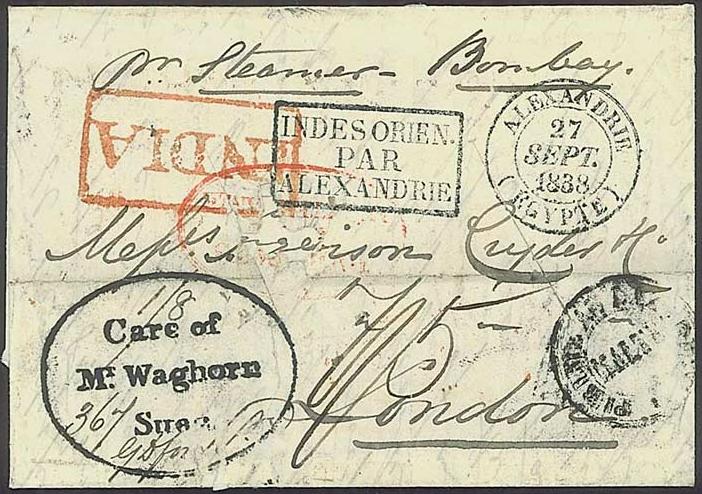
Waghorn Sidebottom 3
The most frequently recorded typeThis is the commonest Waghorn marking in the present census, although individual covers can still be important because of their route, origin, destination or accompanying postal marks.
Full record · COV-2992 →The Recorded Markings
The census presently records 21 Waghorn marking types used between 1836 and 1853.
Most were struck in black, although one type is recorded in red. Some appear in both the Sidebottom and Smith listings. Others were added by Smith, while several markings recorded from surviving covers do not appear in either published catalogue.
The numbers are not intended to suggest that every type was used continuously throughout the stated period. They represent the dates currently established from recorded examples. A newly discovered cover may extend a period of use or add another marking to the census.
Each marking page includes the known date range, colour, catalogue references and the covers presently recorded with that type.


Browse the full agent page — Waghorn forwarding-agent marks & covers.
Rivalry, Decline and Reputation
Waghorn did not create the overland route entirely on his own. The East India Company, the Egyptian administration, shipping companies, local agents and later the P&O all played important parts in its development.
Waghorn’s importance lies in the energy with which he promoted the route and in the practical work he undertook to make it usable. He organised connections, carried mail and passengers, maintained transport across Egypt and demonstrated that communication with India did not have to depend entirely on the voyage around the Cape.
His own accounts sometimes gave him a larger part in the story than modern historians are willing to accept. Even so, his name became inseparable from the early overland mail.
For postal historians, that reputation survives in a more tangible form. It can still be seen in the cachets and manuscript endorsements found on letters that passed through his agency.
Add a Waghorn Cover to the Census
The census is not complete.
Several markings are represented by only one or two covers, and a few recorded types do not appear in the established catalogues. Further examples may establish earlier or later dates, reveal new routes or show that a supposedly rare type was used more widely than presently believed.
Collectors holding a cover with a “Care of Mr Waghorn”, “Waghorn & Co.”, Alexandria, Suez or Cossier forwarding mark are invited to submit it for study and inclusion.
Clear images of the front and reverse are especially useful, together with any known date, origin, destination, auction history and provenance.
Sources & Further Reading
- Thomas Fletcher Waghorn — biography, naval career and the Overland Route (Wikipedia).
- The Overland Route through Egypt — Alexandria, Cairo, Suez and the Red Sea passage (Wikipedia).
- The Egypt Study Circle — research on Waghorn, the forwarding agents and their marks, including the Smith listing.
- Freda Harcourt, “Waghorn, Thomas Fletcher,” Oxford Dictionary of National Biography (2004) — a modern reassessment of the Waghorn legend.
- The Sidebottom and Smith catalogues of the Egyptian and India forwarding-agent markings, as recorded on the Waghorn census pages.
Related guides
Frequently asked
- Who was Thomas Waghorn?
- Thomas Fletcher Waghorn (1800–1850) was an English naval officer and postal pioneer who developed the Overland Route between Britain and India across Egypt, and ran a private forwarding agency handling mail and passengers. His forwarding-agent markings on pre-1854 covers make him one of the best-known names in early Anglo-Indian postal history.
- What was the Overland Route?
- The Overland Route carried mail from Britain to India by way of Egypt: by sea to Alexandria, across the desert through Cairo to Suez, and then down the Red Sea to Bombay. It replaced the long sailing voyage around the Cape of Good Hope, cutting the journey from about three months to roughly five or six weeks.
- What is a Waghorn forwarding-agent mark?
- As letters passed through Waghorn's agency they were struck or endorsed with cachets such as “Care of Mr Waghorn” and “Care of Messrs Waghorn & Co.” These forwarding-agent markings identify covers that travelled through his hands. They are catalogued by their Sidebottom number, cross-referenced to Smith, and recorded cover by cover in this census.
- How did a letter actually travel?
- A recorded 1839 cover shows the mechanics: written in Assam, it went to Calcutta, was registered with Waghorn's agent and struck with the Suez cachet, crossed from Bombay to Suez aboard the EIC steamer Berenice, went overland to Alexandria with Waghorn's couriers, then by H.M. packets Blazer and Mageara to Malta and Marseilles, and reached London in January 1840.
- What was the Cossier route?
- Cossier (El Qoseir) was a Red Sea port that Waghorn sometimes preferred to Suez, with a caravan route across the desert to the Nile and on to Alexandria. Very few covers travelled this way; the “CARE OF MR. WAGHORN / COSSIER” marking is one of the great rarities of the series, with only two examples recorded.
- Was Waghorn the sole creator of the Overland Route?
- No. Modern historians, including the Oxford Dictionary of National Biography, caution that some of Waghorn's own claims were exaggerated and that others — notably the East India Company and later the P&O — were central to establishing the route. His genuine achievement was to demonstrate and popularise the overland idea and to build much of the working infrastructure in Egypt.