
Study · Handstruck Stamps of India
The Indian Bishop Mark
The Story of India’s Earliest Recorded Postmark
By Gowtham BJ · Hand Struck Stamps of India
In February 1775, a folded letter was handed in at the General Post Office in Calcutta for delivery to Dacca. Before it began its journey, a postal clerk pressed a small circular handstamp onto the letter. Divided horizontally, the mark showed a simple date: “2 / FEB.”

To the clerk, it was an ordinary part of the day’s work. Yet that routine action created an important piece of Indian postal history.
The letter now bears the earliest recorded postmark of India and is the earliest known cover carrying an Indian handstruck postal marking. The small divided circle was known as a Bishop mark, a design descended directly from the world’s first postmark.
The World’s First Postmark
The story of the Bishop mark begins in London during the reign of King Charles II.
In 1661, Henry Bishop, then Postmaster General of England, introduced a small circular stamp to be applied to letters passing through the Chief Post Office. The circle, measuring approximately thirteen millimetres across, was divided by a horizontal line. The month appeared in one half and the day in the other.
Bishop introduced the mark for a practical reason: to prevent letters from being deliberately delayed by postal employees. As he explained, the stamp was intended so:
“that no Letter Carrier may dare to detain a Letter from Post to Post, which before was usual.”
By recording the date on which a letter entered the postal system, the mark made postal workers accountable for delays. It was the first postmark ever used.
The design proved effective and was gradually adopted beyond London. Bishop marks appeared in Dublin, Edinburgh and other parts of the British postal system. As British postal administration expanded overseas, the small divided circle travelled with it.
More than a century after Henry Bishop introduced the design in England, a related form of the mark appeared in Bengal.
The Bishop Mark Reaches Calcutta
The authority for introducing a datestamp in India can be traced to Bye-Rule 8 of the Consultations dated 17 January 1774. The rule directed:
“that all letters shall be stamped with the day of the month on which they are delivered into any chief office.”
The new procedure came into operation at the General Post Office in Calcutta on 31 March 1774.
The surviving evidence strongly establishes Calcutta as the place where the Indian Bishop mark was introduced. It remains uncertain whether similar handstamps were supplied to the chief post offices at Madras or Bombay. No confirmed examples from those presidencies are presently recorded, and all known Indian Bishop marks are associated with Calcutta.
The earliest surviving strike is dated 2 February 1775.
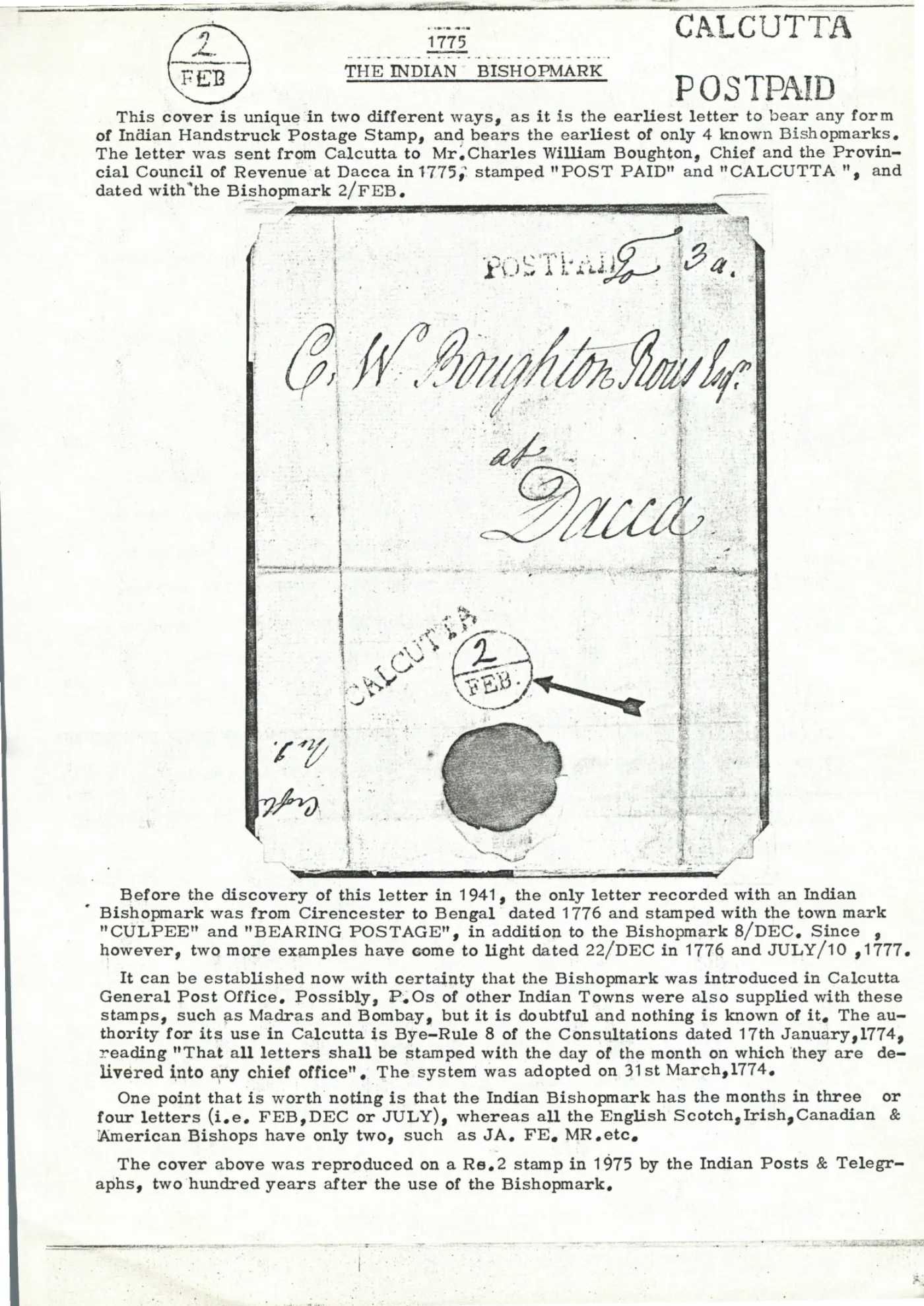
It appears on a pre-stamp letter sent from Calcutta to Charles William Boughton Rous, Chief of the Provincial Council of Revenue at Dacca. The cover is exceptional for two reasons: it is the earliest recorded cover bearing an Indian handstruck postal marking, and it carries the earliest known Indian Bishop mark.
The cover remained unknown to philatelists until its discovery in 1941. It later formed part of the collection of Derek Hammond Giles, the great authority whose catalogue numbers are still used to identify the handstruck postage stamps of India.
In 1975, exactly two centuries after the letter was posted, the Indian Posts and Telegraphs Department reproduced the cover on a Rs.2 commemorative postage stamp issued for the bicentenary of the Indian postal service.
How to Recognise an Indian Bishop Mark
The Indian Bishop mark follows the same basic design as its London predecessor: a circle divided horizontally, with the day and month placed in the two halves. However, the Indian marks have several distinctive characteristics.
Most noticeably, the month is normally written in three or four letters — FEB, DEC, JULY. British, Irish, Scottish, Canadian and American Bishop marks usually abbreviated the month to only two letters, such as JA, FE or MR. The Indian marks are also considerably larger than the original thirteen-millimetre London design.
The arrangement of the date changed over time. On the earlier Calcutta marks, the day appeared in figures above the dividing line and the abbreviated month below. On later examples, this arrangement was reversed, with the month placed above and the date below.
Other postal markings were normally applied separately. A letter on which postage had already been paid received a straight-line “POST PAID” handstamp. Letters for which postage remained to be collected were marked “BEARING POSTAGE.” The town name, usually “CALCUTTA”, was applied with a separate straight-line handstamp. On certain related covers, the name “CULPEE” appears instead. Where a postal rate was shown, it was generally entered by hand or struck separately beside the postal markings.
Dating the Marks by Measurement
The Calcutta General Post Office appears to have intended that the design of the Bishop handstamp should be altered periodically, probably each year. For collectors, this provides an unusually useful method of identification. The length of the horizontal dividing line changed from one issue to another, allowing many strikes to be dated by measurement even when the impression is incomplete or indistinct.
| Year | Dividing line | Arrangement |
|---|---|---|
| 1775 | 18 mm | Date above; abbreviated month below |
| 1776 | 16½–17 mm | Date above; abbreviated month below |
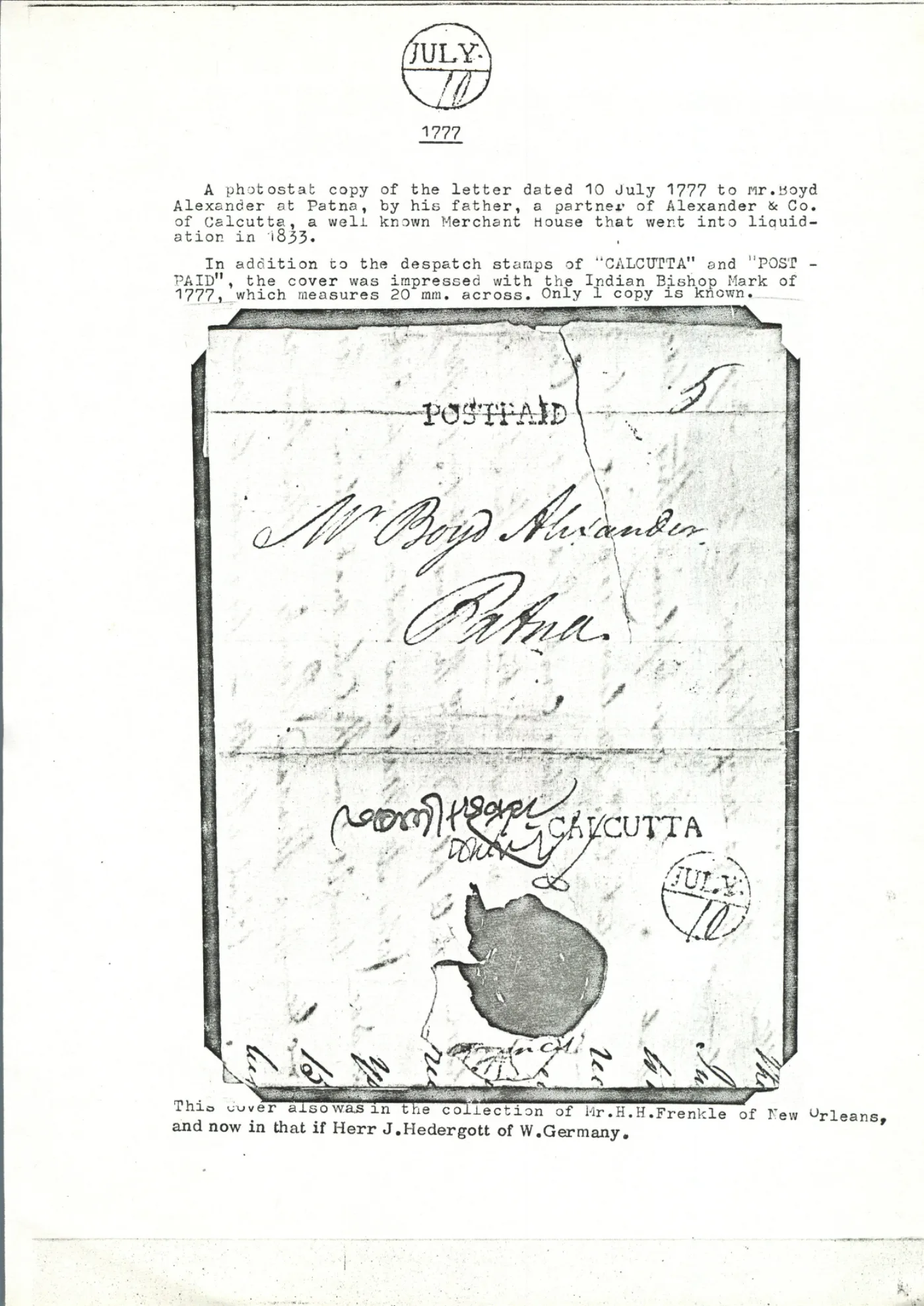
| 1777 | 20 mm | Month written in full above; date below |
The change introduced in 1777 was particularly noticeable. The month was moved into the upper half of the circle and written in full, with the date below it. This clearly distinguished the 1777 handstamp from the designs used in 1775 and 1776.
When a strike is faint, damaged or partly obscured by a fold, a difference of only a few millimetres in the dividing line can determine whether an attribution is reliable or merely speculative.
The Calcutta Bishop Marks by Month
The Calcutta Bishop mark appears to have been prepared separately for different months of the year. As a result, the office used a family of closely related marks, beginning with January and continuing through the calendar.


The February mark, Calcutta X2, is the most historically important because it includes the strike dated 2 February 1775 — the earliest recorded Indian postmark. The July mark, Calcutta X7, represents the altered 1777 design, on which “JULY” is written in full above the dividing line with the date below. The December mark, Calcutta X12, is recorded with a dividing line of approximately 16½ millimetres, the day above and the abbreviated month below.
Recorded Bishop-Mark Covers
The following pre-stamp covers are presently recorded in connection with the Calcutta Bishop marks. Each provides evidence not only of the handstamp itself but also of the routes, rates and administrative practices of the early Bengal postal system.

2 February 1775 — Calcutta to Dacca
- Catalogue:
- Calcutta X2
- Addressee:
- Charles William Boughton Rous
- Destination:
- Dacca
This is the earliest recorded Indian handstruck cover.
It bears the 2/FEB Bishop mark, together with the straight-line “CALCUTTA” and “POST PAID” handstamps. The letter was addressed to Charles William Boughton Rous, Chief of the Provincial Council of Revenue at Dacca.
The cover was discovered in 1941 and later belonged to Derek Hammond Giles. It was reproduced on the Rs.2 Indian postal bicentenary stamp issued in 1975.

2 December 1776 — Culpee to Bengal
- Catalogue:
- Calcutta X12
- Addressee:
- Mr Justice Chambers
- Markings:
- “CULPEE,” “BEARING POSTAGE” and 2/DEC Bishop mark
This incoming cover bears the December Bishop mark with a dividing line measuring approximately 16½ millimetres. It is particularly interesting because it demonstrates the use of the Bengal datestamp on mail entering the Calcutta postal system, rather than only on mail leaving Calcutta.

22 December 1776 — Calcutta to Murshidabad
- Catalogue:
- Calcutta X12
- Route:
- Calcutta to Murshidabad
This cover was one of the four examples included in the Bishop-mark census published in The Philatelist in March 1962.
The letter was written by Claud Alexander to Boyd Alexander. It carries the December 1776 form of the Bishop mark, with the date above the abbreviated month.

10 July 1777 — Calcutta to Patna
- Catalogue:
- Calcutta X7
- Addressee:
- Boyd Alexander
- Destination:
- Patna
This is the first recorded example of the redesigned 1777 Bishop mark.
The word “JULY” appears in full in the upper half of the circle, while the date appears below. The dividing line measures approximately 20 millimetres. The cover also bears a “POSTPAID” marking and the postal rate “5.”
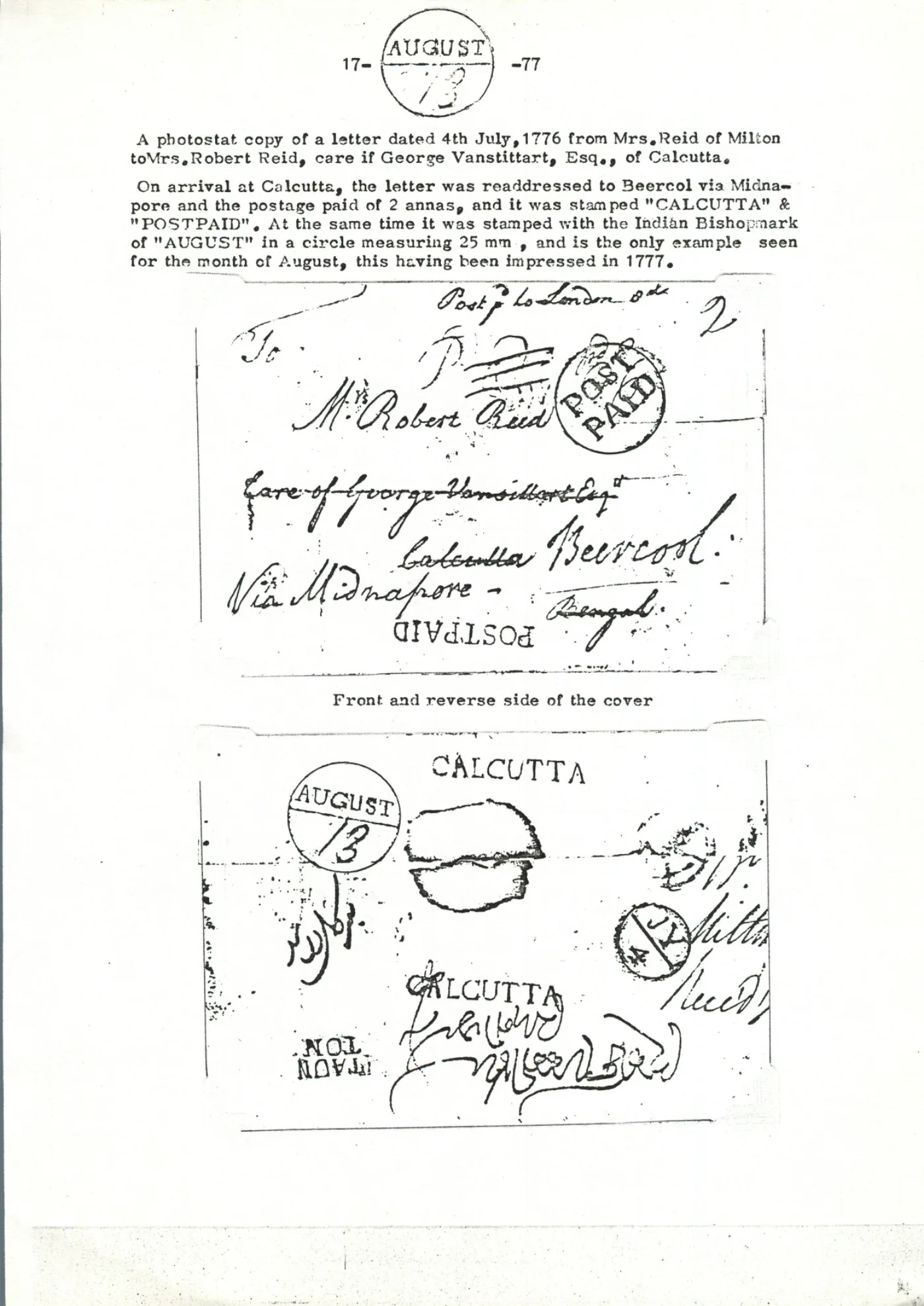
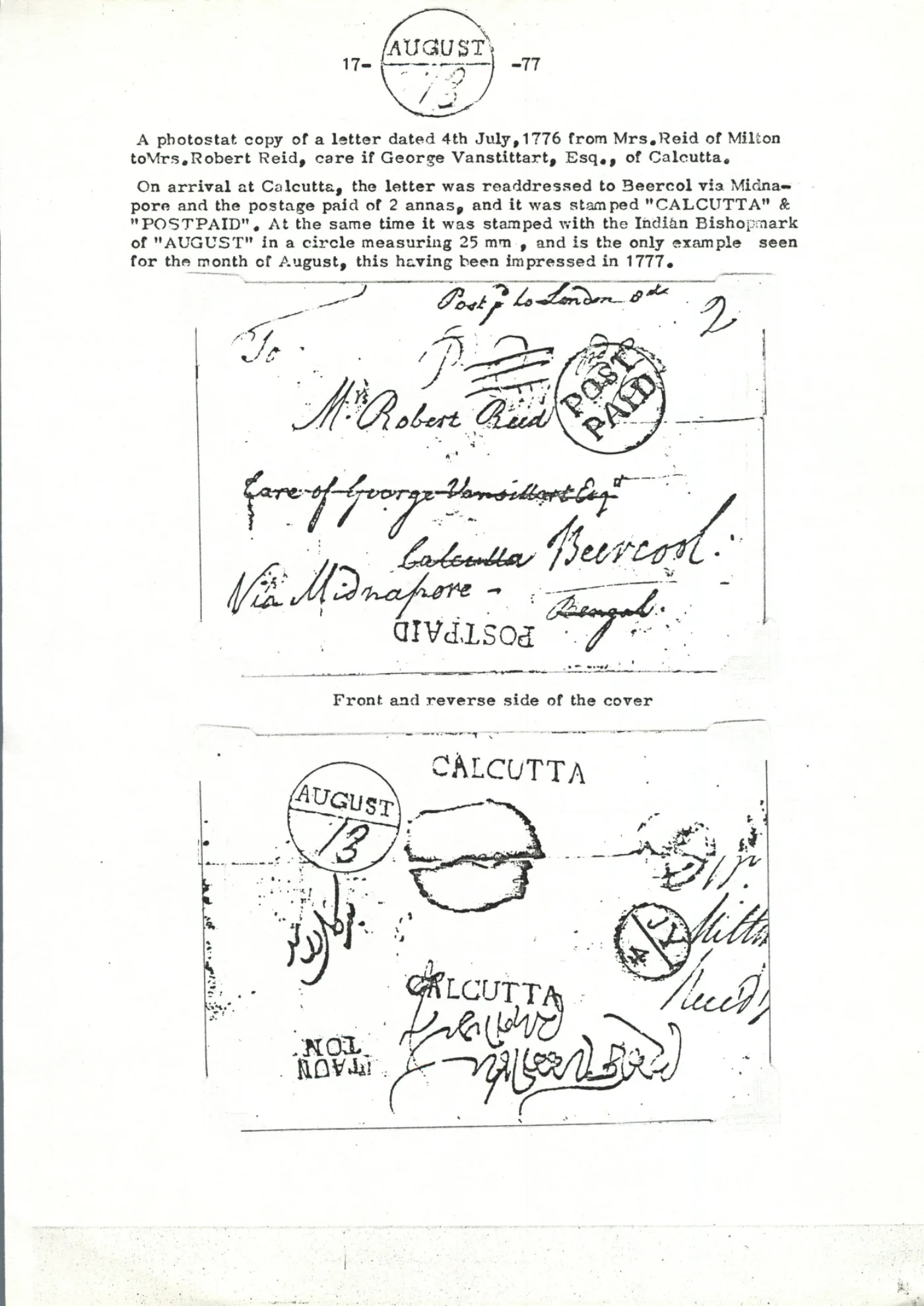
13 August 1777 — Calcutta to Beercool
- Catalogue:
- Calcutta X8
- Route:
- Calcutta to Beercool
This cover carries the August form of the 1777 Bishop mark. Like the July issue, it belongs to the later layout in which the month was positioned above the dividing line.

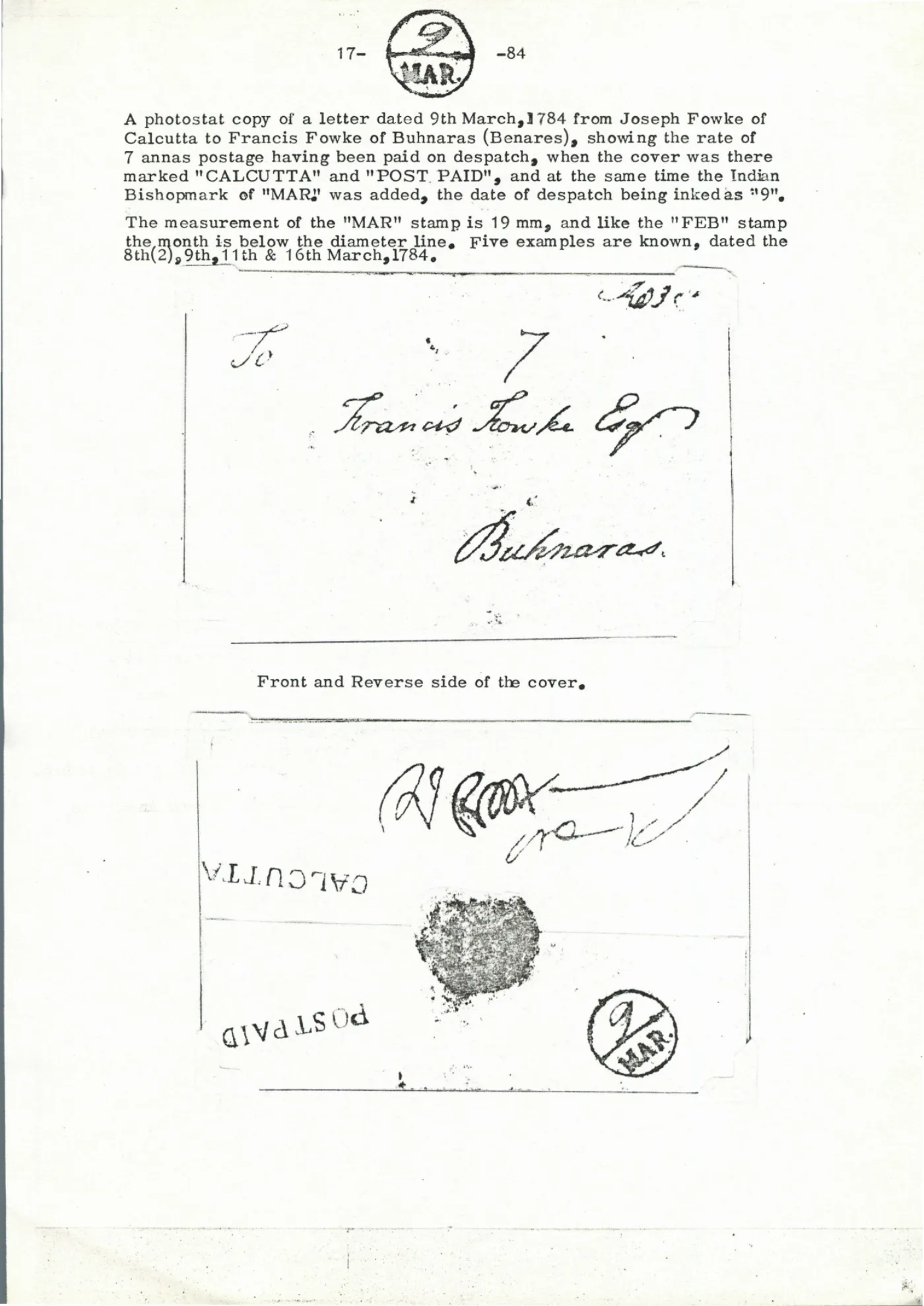
9 March 1784 — Calcutta to Benares
- Catalogue:
- Calcutta X3
- Addressee:
- Francis Fowke
- Destination:
- Benares
This letter bears the March form of the Calcutta Bishop mark and forms part of a small group of surviving 1784 letters sent from Calcutta to Francis Fowke at Benares.

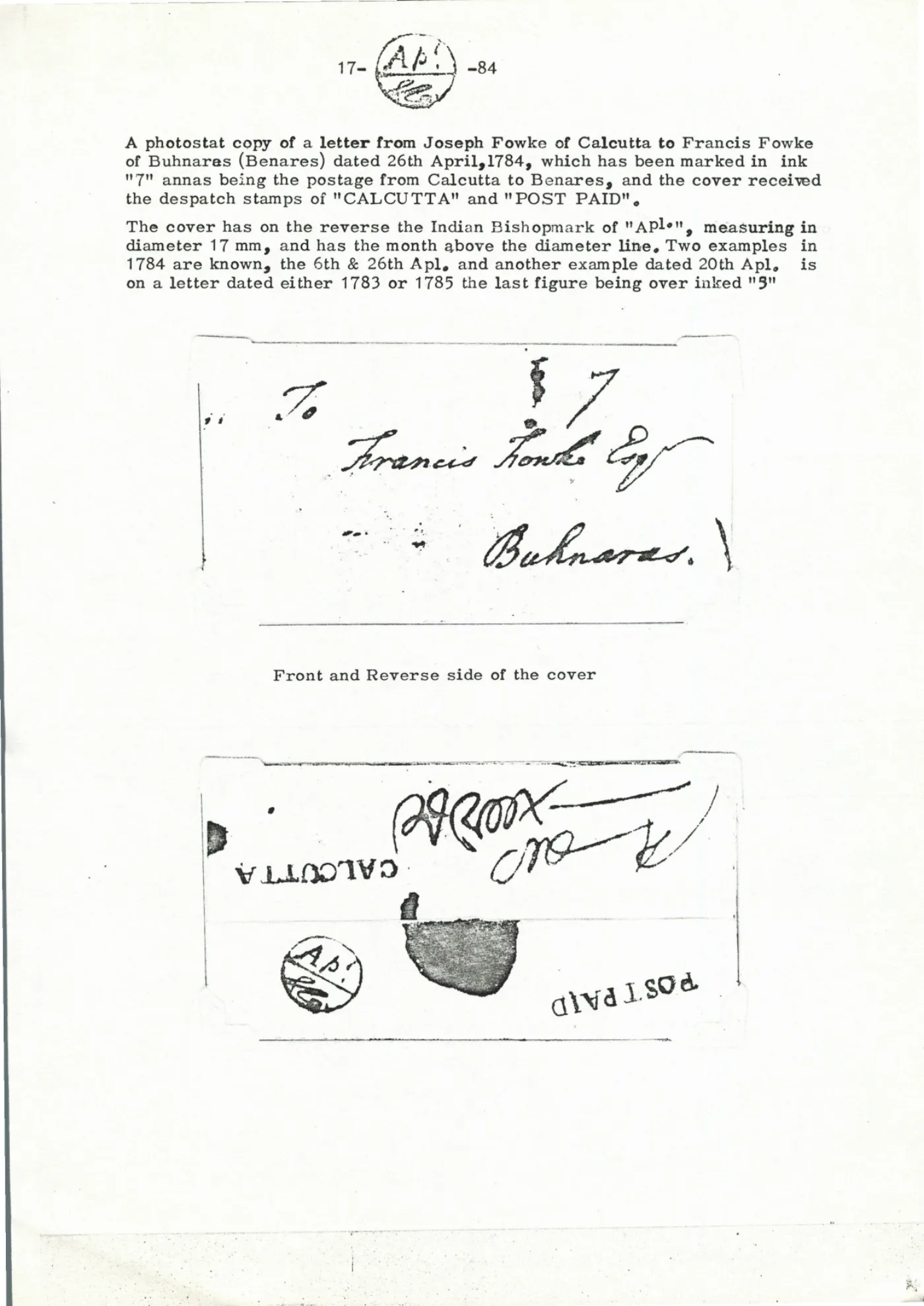
26 April 1784 — Calcutta to Benares
- Catalogue:
- Calcutta X4
- Addressee:
- Francis Fowke
- Destination:
- Benares
The April strike appears on another letter addressed to Francis Fowke. Together with the March, May and June examples, it helps document the continued use of the monthly Bishop marks in the 1780s.

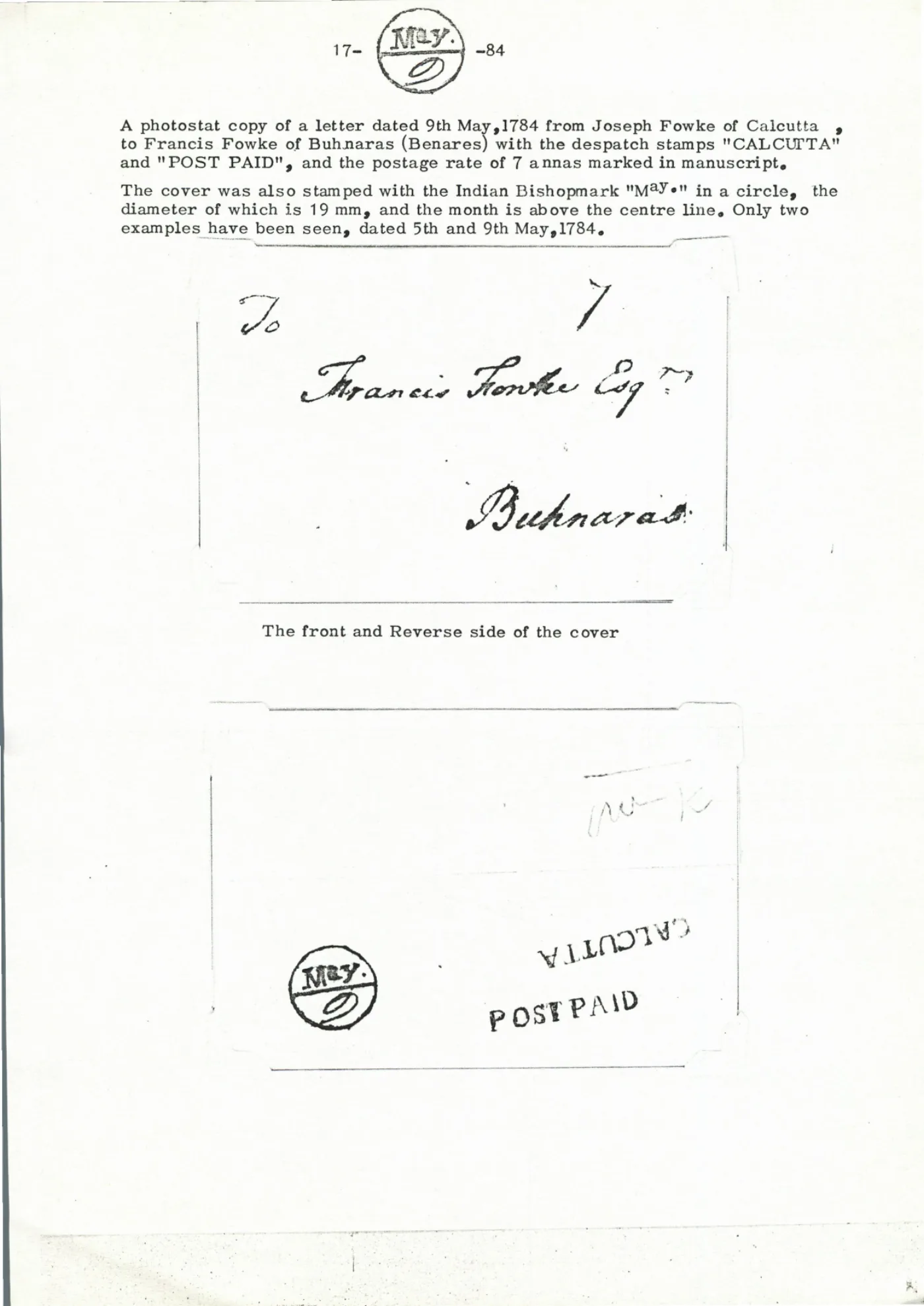
9 May 1784 — Calcutta to Benares
- Catalogue:
- Calcutta X5
- Addressee:
- Francis Fowke
- Destination:
- Benares
This cover carries the May form of the Calcutta Bishop mark on the Calcutta–Benares route.
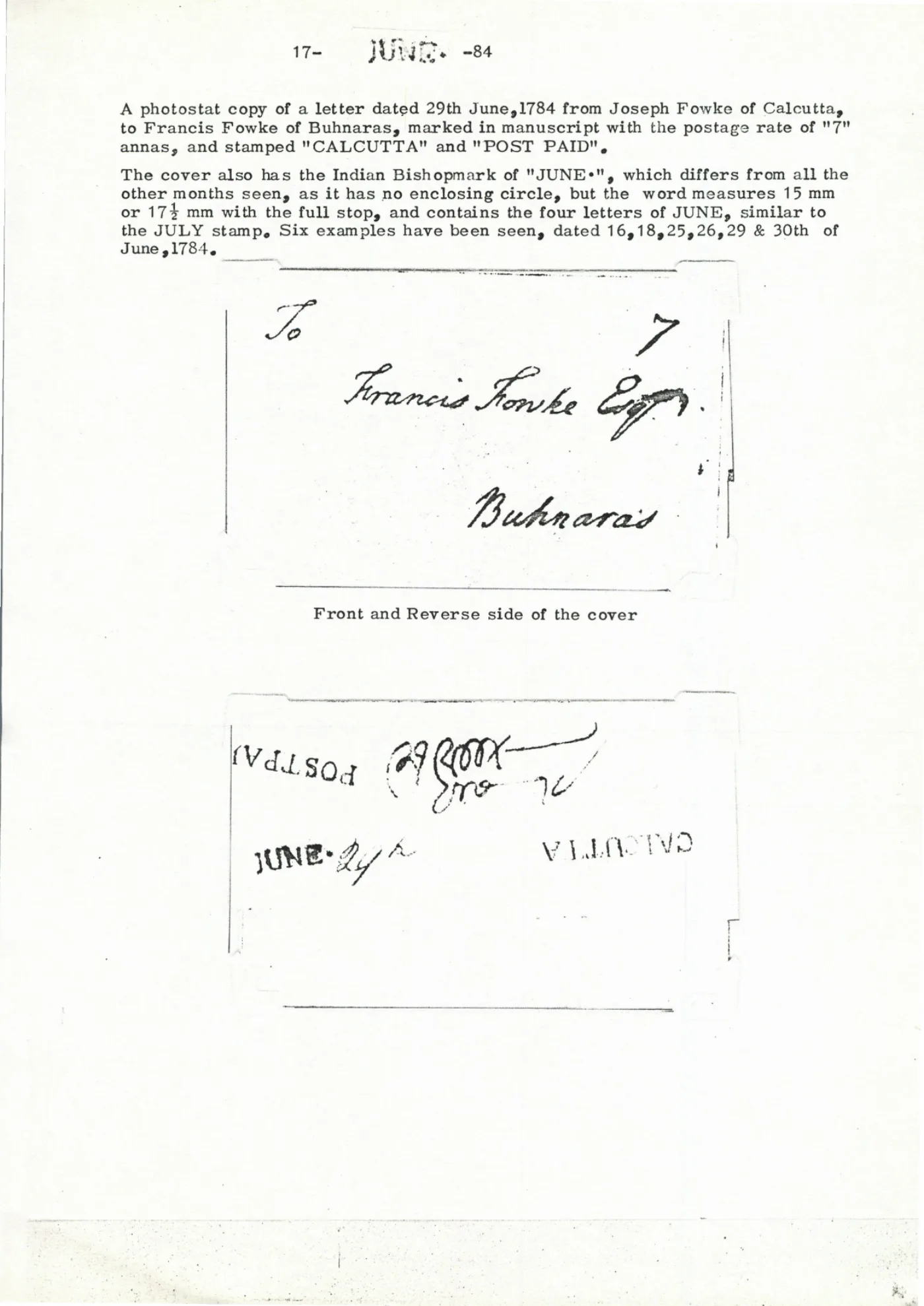
29 June 1784 — Calcutta to Benares
- Catalogue:
- Calcutta X6
- Addressee:
- Francis Fowke
- Destination:
- Benares
The June 1784 strike completes the recorded sequence of March, April, May and June letters sent to Francis Fowke.
Evidence from the Giles Papers
Much of what is known about these marks survives because of the careful work of Derek Hammond Giles.
Giles did not merely list the handstamps. He examined the original covers, reproduced the strikes on his reference sheets, measured their dimensions and recorded their dates, routes and accompanying postal markings. His working papers preserve the evidence from which the modern census was developed.
These reference sheets remain valuable because they preserve information about covers that may later have changed ownership, disappeared into private collections or become difficult to examine directly.
The Published Census
For much of the twentieth century, Indian Bishop marks were considered among the greatest rarities of early Indian postal history.
An article titled “A New Indian Bishop Mark” appeared in the October 1961 issue of The Philatelist. Giles subsequently wrote to correct and expand the information, and a formal census was published in the March 1962 issue. At that time, only four examples were recorded anywhere in the world:
| No. | Date | Journey | Dividing line | Owner |
|---|---|---|---|---|
| 1 | 2 February 1775 | Calcutta to Dacca | 18 mm | D. Hammond Giles |
| 2 | December 1776 | Cirencester to Calcutta | ≈ 16½ mm | Foster Bond |
| 3 | 22 December 1776 | Calcutta to Murshidabad | ≈ 16½ mm | H. H. Frenkle |
| 4 | 10 July 1777 | Calcutta to Patna | 20 mm | H. H. Frenkle |
Since 1962, further examples have been identified through auction catalogues, private collections, institutional archives and reports from specialists. The presently recorded monthly marks include:
| Mark | Month | Recorded date | Journey |
|---|---|---|---|
| Calcutta X1 | January | Not established | Calcutta |
| Calcutta X2 | February | 2 February 1775 | Calcutta to Dacca |
| Calcutta X3 | March | 9 March 1784 | Calcutta to Benares |
| Calcutta X4 | April | 26 April 1784 | Calcutta to Benares |
| Calcutta X5 | May | 9 May 1784 | Calcutta to Benares |
| Calcutta X6 | June | 29 June 1784 | Calcutta to Benares |
| Calcutta X7 | July | 10 July 1777 | Calcutta to Patna |
| Calcutta X8 | August | 13 August 1777 | Calcutta to Beercool |
| Calcutta X12 | December | 22 December 1776 | Calcutta to Murshidabad |
This list should not be treated as permanently complete. New discoveries continue to alter the recorded census of early Indian postal markings.
Claud and Boyd Alexander
Several surviving Bishop-mark letters were written by Claud Alexander of Calcutta to Boyd Alexander.
The Alexanders belonged to a family closely connected with the commercial life of British India. Their firm, Alexander & Company, later became an important Calcutta agency house and bank. Among its notable financial dealings was the management of prize money belonging to Lord Combermere. The firm eventually failed in 1832, during the wider collapse of several Calcutta agency houses.
The surviving correspondence between members of the Alexander family provides more than postal evidence. It also offers a glimpse into the commercial and personal networks through which letters travelled in eighteenth-century India.
Incoming as Well as Outgoing Mail
The Cirencester-to-Calcutta cover recorded in the 1962 census is especially significant.
It shows that the Bengal Bishop mark was not confined to letters posted at Calcutta for inland delivery. The mark could also be applied to incoming mail after it entered the Bengal postal system.
This broadens our understanding of how the handstamp was used. It was not simply a departure mark. Its purpose was to record when a letter was received into the chief office, whether the letter had originated in Bengal or arrived from overseas.
Was the Calcutta Bishop Mark Really India’s First?
The 2 February 1775 Calcutta Bishop mark is the earliest recorded Indian postmark on a complete cover. On present evidence, it remains the earliest firmly established Indian handstruck postal marking of its kind. However, the question is not entirely closed.
In his supplement, Giles recorded that a handstamp from Chicacole, in the Madras Presidency, may already have existed in 1775. An example on piece, accompanied by a certificate from the British Philatelic Association, has been attributed to as early as 1773.
Should that date and attribution eventually be accepted without reservation, the beginning of Indian handstruck postal history would move back by two years.
This is one of the reasons early postal history must always be described carefully. “The earliest” usually means the earliest example presently recorded and accepted. A newly discovered cover, archive entry or contemporary postal instruction may still change the story.
Add a Bishop Mark to the Census
Every recorded Calcutta Bishop mark contributes to a better understanding of India’s early postal system. A previously unrecorded strike may establish a new date of use, reveal an unknown month, extend an existing period of use, confirm a postal route, identify a different handstamp state, or add a new cover to the census.
Collectors who own a Calcutta Bishop-mark cover, an unrecorded date or a clearer strike are encouraged to submit the details for study through the census of the Calcutta marks. Even a partial or faint impression can be important when supported by a complete cover, reliable provenance or measurable characteristics.
Acknowledgements and Sources
This study draws extensively on the papers and published research of Derek Hammond Giles, as well as material preserved and studied by members of the India Study Circle for Philately. Their work has been fundamental to the identification, classification and recording of the Indian Bishop marks.
- D. Hammond Giles, “Indian Bishop Mark,” The Philatelist, November 1961, p. 36.
- “A New Indian Bishop Mark,” The Philatelist, October 1961, p. 5.
- “Indian Bishop Marks,” The Philatelist, March 1962, p. 117.
- D. Hammond Giles, The Handstruck Postage Stamps of India, manuscript and published editions.
- Robson Lowe, The Encyclopaedia of Empire Postage Stamps, Volume III.
- Historical records relating to Henry Bishop and the introduction of the first postmark in London in 1661.
Frequently asked
- What is a Bishop mark?
- A Bishop mark is the earliest form of postal datestamp. It consists of a small circle divided by a horizontal line, with the day and month shown in the two halves. It takes its name from Henry Bishop, Postmaster General of England, who introduced the design in London in 1661. Its purpose was to show when a letter entered the postal system and prevent postal workers from deliberately delaying the mail.
- What is the Indian Bishop mark?
- The Indian Bishop mark is the earliest recorded form of Indian postmark. It was used at the General Post Office in Calcutta and consisted of a divided circle showing the day and month. The design was derived directly from the Bishop mark first introduced in London in 1661.
- When was the Bishop mark introduced in India?
- The authority for its introduction appears in Bye-Rule 8 of the Consultations dated 17 January 1774. The rule required letters to be stamped with the day of the month on which they were delivered into a chief office. The procedure came into force at the Calcutta General Post Office on 31 March 1774. The earliest surviving example presently recorded is dated 2 February 1775.
- How does the Indian Bishop mark differ from the English mark?
- The Indian Bishop mark is generally larger than the original London mark. The Indian version usually gives the month in three or four letters, such as “FEB,” “DEC” or “JULY.” British and other Bishop marks generally used only two letters, such as “FE” or “JA.” The size and arrangement of the Indian marks also changed over time, allowing certain examples to be dated by measuring the dividing line.
- Which is the earliest recorded Indian Bishop mark?
- The earliest recorded example is the 2 February 1775 Calcutta Bishop mark on a pre-stamp letter sent to Charles William Boughton Rous at Dacca. It is also the earliest known complete cover carrying any Indian handstruck postal marking. The cover was discovered in 1941, later belonged to Derek Hammond Giles and was reproduced on India's Rs.2 postal bicentenary stamp in 1975.
- How many Indian Bishop marks are known?
- Only four examples were recorded when the standard census was published in The Philatelist in March 1962. Additional examples have since been identified, including monthly marks for January, February, March, April, May, June, July, August and December. Because new covers may remain in private collections or unexamined archives, the census should be regarded as an evolving record rather than a final total.
- Were Bishop marks used outside Calcutta?
- Confirmed Indian Bishop marks are associated with Calcutta. It is uncertain whether Madras or Bombay received comparable datestamps during the same period. No securely recorded examples from those presidencies are presently known.
- Why are Indian Bishop marks important?
- Indian Bishop marks document the beginning of systematic postal dating in India. They also provide evidence about early postal administration, inland routes, postage payment, incoming and outgoing mail, and the development of the East India Company's postal system. Because so few examples survive, every genuine cover can add important information to the recorded history of India's posts.