
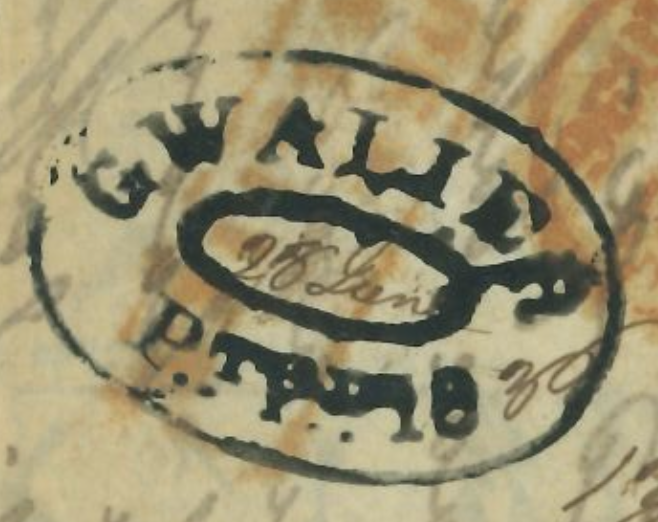

North Western Provinces · Pre-1854 Handstamp
Gwalior HG 4b
- Colour & date
- Black1834–1836
- Rarity
- Rare
- Catalogue
- 2000 Supplement · p. 8
- Figure
- 4b
- Submitted by
- D. Hammond Giles
Census
Census records
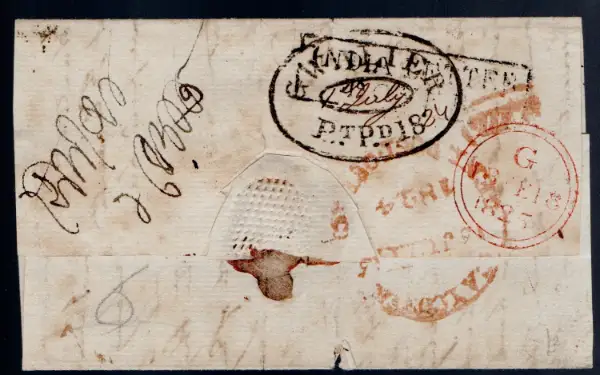
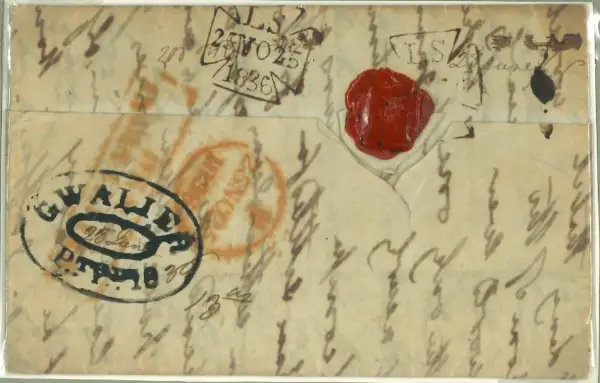
2 covers recorded2 pre-1854 covers bearing the Gwalior HG 4b handstamp are recorded below — each entry links to images, provenance and auction details.
About this mark
The Gwalior HG 4b handstamp
Gwalior State was the largest treaty State in the Central India Agency, under the political supervision of a Resident at Gwalior, the original capital of the State, though later replaced by Lashkar. Gwalior fort is one of the most famous in India. The house of Sindhia founded by Ranoji Sindhia, and during the latter part of the 18th century, with the assistance of Benoit De Boigne and his genius for organisation and command in the field, the Maratha supremacy was established. In 1843 a British force under Sir Hugh Gough moved on Gwalior, and during the battles of Panniar and Maharajpur, the Gwalior army was annihilated. A Council of Regency was then appointed during the minority of an adopted son of the former ruler's widow, to act under the Resident's advice.
Gwalior HG 4b is a pre-1854 handstruck postal marking of the post office at Gwalior in the North Western Provinces, British India, in recorded use from 1834 to 1836. Known strikes are in black. It is listed in 2000 Supplement, where each marking of British India is assigned a figure number — hence "HG 4b".
2 surviving covers bearing this mark are recorded in the census, each with images and provenance. On the strength of that count the mark is graded "Rare" — the grade moves automatically as new covers are recorded. Collectors searching for gwalior pre stamp covers, gwalior postal history or "Gwalior HG4b" material can compare HG 4b across every office or browse the rest of the Gwalior marks.
Frequently asked
- What is the Gwalior HG 4b handstamp?
- Gwalior HG 4b is a pre-1854 handstruck postal marking of Gwalior in the North Western Provinces, British India, in recorded use from 1834 to 1836. The "HG 4b" designation is its figure number in the Hammond Giles catalogue of the handstruck postage stamps of India. Known strikes are in black.
- How rare is Gwalior HG 4b?
- Gwalior HG 4b is graded "Rare" in this census. Rarity here is evidence-based: it is derived from the number of surviving covers actually recorded, not estimated. 2 surviving covers bearing this mark are recorded in the census, each with images and provenance.
- What does a Gwalior pre stamp cover with HG 4b look like?
- A pre stamp (pre philatelic) cover from Gwalior is a folded letter or envelope carried before India's first adhesive stamp of 1854, with postage shown entirely by hand-struck marks like HG 4b. 2 surviving covers bearing this mark are recorded in the census, each with images and provenance. Each census record on this page links to full cover images, dates and auction provenance.
- How do I identify or submit a Gwalior HG 4b cover?
- Compare your cover against the reference impression and recorded examples on this page — check the mark's shape, colour and date range (1834–1836). If your cover is not already recorded, you can submit front and back photographs through the census form on this page; every submission is editor-reviewed before publication.
Same office
Other recorded marks at Gwalior
9 marks9 other pre-1854 postal markings of Gwalior are recorded in the census. Compare their figure numbers, dates and colours to identify the mark on your cover.
Suggest a correction
Spotted a wrong date, colour or rarity? Propose a change — every suggestion is reviewed before it is applied.
Also searched as: Gwalior HG 4b, Gwalior HG4b, Gwalior Giles 4b, Gwalior handstamp, Gwalior pre stamp cover.
How to cite
“Gwalior HG 4b — handstamp,” Hand Struck Stamps, https://handstruckstampsindia.com/n-w-provinces/gwalior/hg-4b (accessed 24 September 2026).
Updated: 24 Sept 2026