
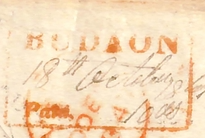
North Western Provinces · Pre-1854 Handstamp
Bodaon HG 1
- Colour & date
- Red1847
- Rarity
- Rare
- Figure
- 1
- Submitted by
- Argyll Etkin
Census
Census records
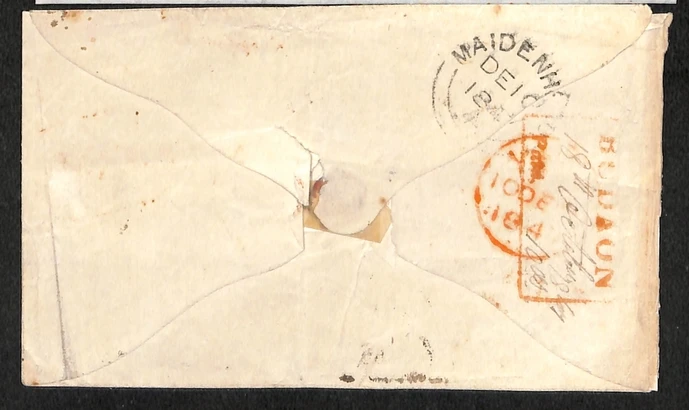
1 cover recorded1 pre-1854 cover bearing the Bodaon HG 1 handstamp is recorded below — each entry links to images, provenance and auction details.
About this mark
The Bodaon HG 1 handstamp
Budaun (romanised: Badāʾūn or Badāyūn, Hindi pronunciation: [bəd̪aːjũː]) is a medieval city and headquarters of Budaun district, in the Indian state of Uttar Pradesh. According to the (Budaun District, Govt. of Uttar Pradesh) mythological stories, Budaun was named after prince Budh Ahir.[8] The local tradition regarding this city is that it was founded in 905 A.D. by a prince whose name was Budh and after whom it was called Budaun. The ruins of Prasidh (a town on the Ramganga) and the coins discovered at Pachoma near Bareilly point to the existence of an Ahir dynasty around the borders of Badaun and Bareilly in the distant past. An inscription, probably of the 12th century, gives a list of twelve Rathore kings reigning at Budaun then called Vodamāyuta. Kanauj was conquered after 1085 by Mahmūd, the son of the Ghaznavid Sultān, driving out the Rāshtrakūta chief. This the Rāshtrakūta chief then move their capital to Vodamāyuta, where they ruled until conquered by Qutb-ud-din Aibak.
Bodaon HG 1 is a pre-1854 handstruck postal marking of the post office at Bodaon — the present-day Budaun — in the North Western Provinces, British India, recorded in use around 1847. Known strikes are in red. Its "HG 1" designation is the figure number assigned in the Hammond Giles catalogue of the handstruck postage stamps of India.
A single surviving cover bearing this mark is recorded in the census, with images and provenance. On the strength of that count the mark is graded "Rare" — the grade moves automatically as new covers are recorded. Collectors searching for bodaon pre stamp covers, bodaon postal history or "Bodaon HG1" material can compare HG 1 across every office or browse the rest of the Bodaon marks.
Frequently asked
- What is the Bodaon HG 1 handstamp?
- Bodaon HG 1 is a pre-1854 handstruck postal marking of Bodaon (modern Budaun) in the North Western Provinces, British India, recorded in use around 1847. The "HG 1" designation is its figure number in the Hammond Giles catalogue of the handstruck postage stamps of India. Known strikes are in red.
- How rare is Bodaon HG 1?
- Bodaon HG 1 is graded "Rare" in this census. Rarity here is evidence-based: it is derived from the number of surviving covers actually recorded, not estimated. A single surviving cover bearing this mark is recorded in the census, with images and provenance.
- What does a Bodaon pre stamp cover with HG 1 look like?
- A pre stamp (pre philatelic) cover from Bodaon is a folded letter or envelope carried before India's first adhesive stamp of 1854, with postage shown entirely by hand-struck marks like HG 1. A single surviving cover bearing this mark is recorded in the census, with images and provenance. Each census record on this page links to full cover images, dates and auction provenance.
- How do I identify or submit a Bodaon HG 1 cover?
- Compare your cover against the reference impression and recorded examples on this page — check the mark's shape, colour and date range (1847). If your cover is not already recorded, you can submit front and back photographs through the census form on this page; every submission is editor-reviewed before publication.
Suggest a correction
Spotted a wrong date, colour or rarity? Propose a change — every suggestion is reviewed before it is applied.
Also searched as: Bodaon HG 1, Bodaon HG1, Bodaon Giles 1, Budaun postal history, Bodaon handstamp, Bodaon pre stamp cover.
How to cite
“Bodaon HG 1 — handstamp,” Hand Struck Stamps, https://handstruckstampsindia.com/n-w-provinces/bodaon/hg-1 (accessed 16 October 2026).
Updated: 16 Oct 2026