Skip to content
Hand Struck Stamps
Handstruck stamp of India — Agra HG 13 pre-1854 handstamp, 1846–1850, Red

North Western Provinces · Pre-1854 Handstamp

Agra HG 13

Colour & date
Red1846–1850
Rarity
Common
Note
"AGRA" close setting
Catalogue
1989 Catalogue · p. 11
Figure
13
Submitted by
D. Hammond Giles

Census

Census records

5 covers recorded

5 pre-1854 covers bearing the Agra HG 13 handstamp are recorded below — each entry links to images, provenance and auction details.
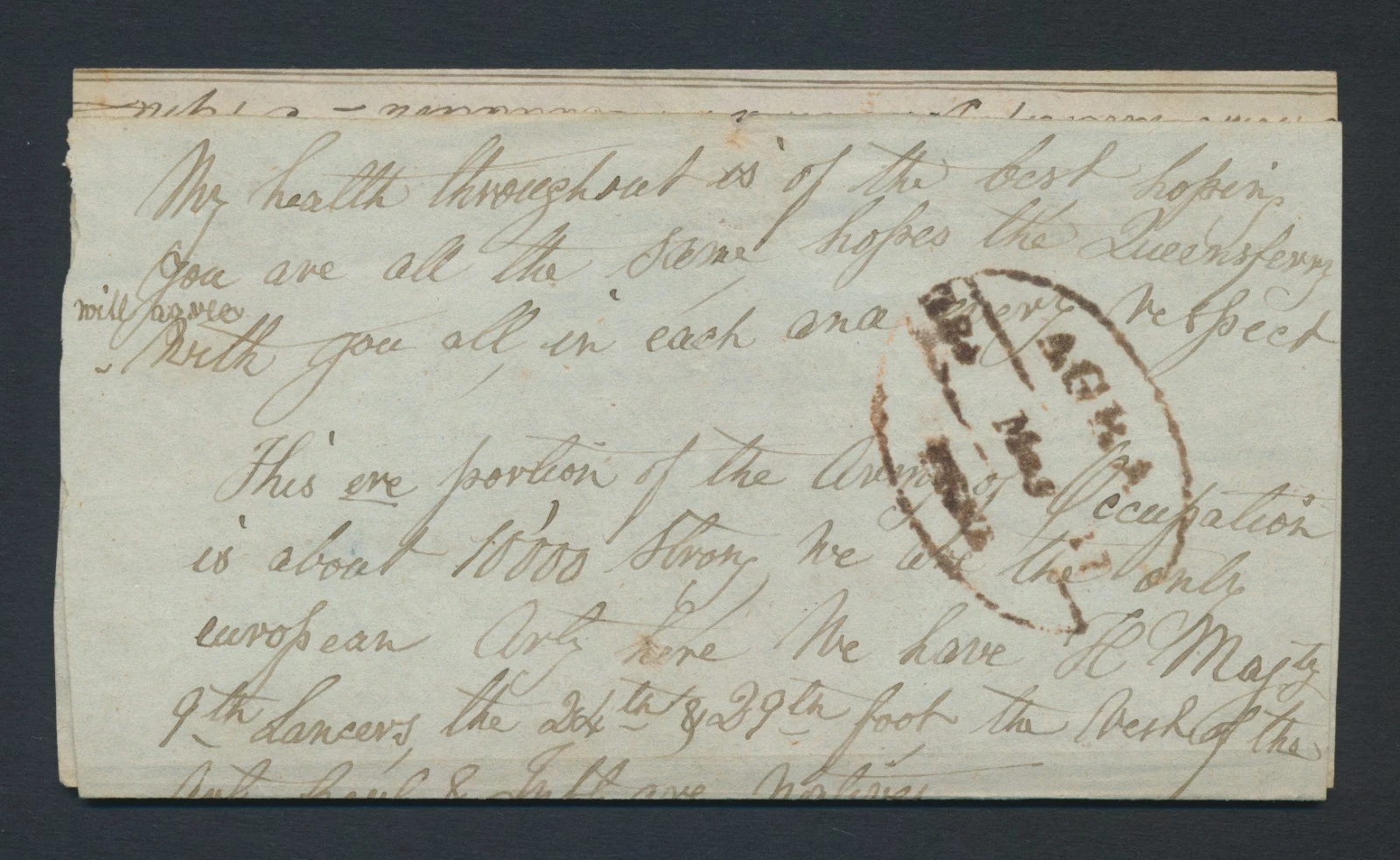
Pre-stamp cover of India — Agra HG 13, COV-5710, 1846
COV-5710

1846

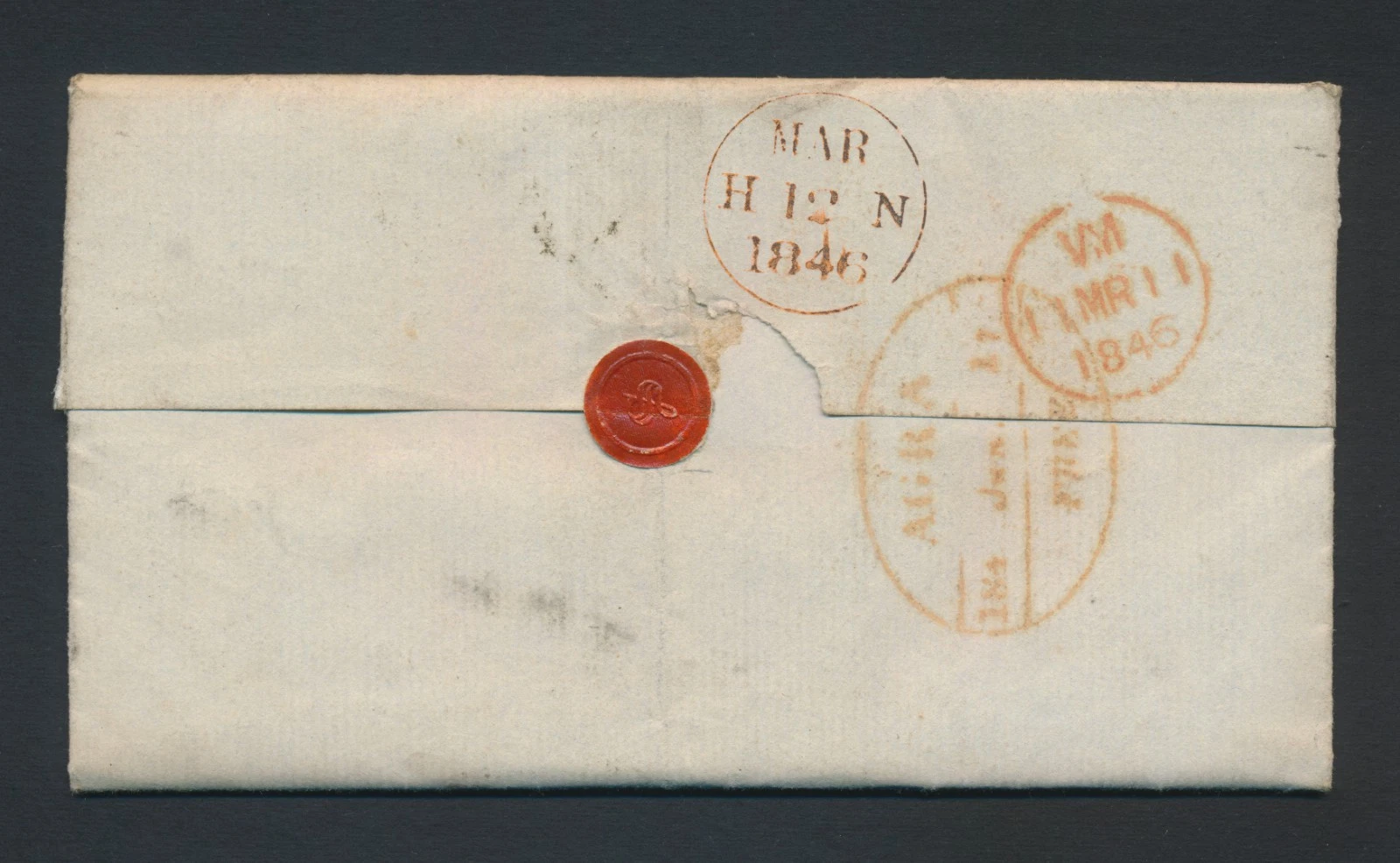
1846 INDIA COVER FIRST ANGLO-SIKH WAR MUDKI, FEROZESHAH ARMY LETTER TO SCOTLAND A superb, deeply historical stampless soldier's concessionary letter mailed from the East India Company cantonment at Agra to Edinburgh, Scotland, in early 1846. This lot includes the whole cover wrapper with original manuscript letter, and a complete 2-page modern typewritten transcription of the contents. Philatelic Identification & Routing: Sender & Authorisation: The outer wrapper is endorsed "From Gunr John Hamilton 1st Coy 1st Battn Arty Agra, East Indies" and is countersigned by "G. R. Crawford, Lieut & Adjt / Commanding 1st Battalion Artillery" to authorize the military concessionary rate. Routing & Marks: The front panel bears a distinct, curved red "INDIA" handstamp. The reverse features a faint red Agra dispatch mark dated Jan 17, 1846, alongside clear red transit/arrival datestamps including a double-ring "MAR / H 12 N / 1846" and a circular "VM / 11 MR 11 / 1846". Address: Addressed to Mrs Margaret Hamilton, 5 South Richmond St, Edinburgh, Scotland. Historical Archival Content (First Anglo-Sikh War & The Potato Famine): The enclosed transcribed text (dated January 16, 1846) is a phenomenal primary source detailing several massive historical events of the 1840s: Battles of Mudki & Ferozeshah: Writing just weeks after the outbreak of the First Anglo-Sikh War, Hamilton discusses the "large army assembled on our North-Western Frontiers" and the bloody engagements that had just occurred. He notes the staggering casualties: "our loss in the two battles already fought - Ferozeshaar & Mudkee - is upwards of 3300, including offiers & men; among the former some of our best Generals". The Spoils of War ("Lifting"): Far from being relieved to be stationed away from the fighting, he bitterly complains about missing out on the plunder. He laments being kept back when "so much gold and jewellery, is to be had for the lifting", viewing it as a missed "golden opportunity again of making a fortune". The Gwalior Star: Hamilton mentions sending his brother an exact copy of the medal his brother Bob wears for the 1843 Gwalior campaign. He provides a superb physical description of the medal's manufacture: "The centre and little star is of silver, set in the larger star, which is of bronze, made from the guns that were taken in the battle". The Potato Famine: In a stark reminder of the global crises of the era, he references the catastrophic 1845/46 agricultural blight affecting the UK, stating: "We hear with regret of the failure of the potatoe crop, and the misery that will entail on our countrymen at home thereby". Condition Notes: The original folded wrapper exhibits standard transit wear, age-related toning, and a clear, intact red wax seal on the reverse. The original manuscript text is visible and intact. Sold with a full 2-page modern typewritten transcription. Sold exactly as photographed. Full Transcription of the Letter Text Agra; East Indies, 16th Jany 1846. My dear Mother, Another year has just slipped past, and here we are as happy, as healthy, & as well to do as ever we were before; with every prospect, at present, of the same blessings for many a year to come. How does it fare with yourself, & Andrew, and the lave? We hope you enjoy good health, and though your purse may not be full, we hope it may never be empty. We are happy to inform you that the 50 Rupees was duly paid in on the 1st Inst., for which you will receive 5 Pounds, about the beginning of March - being the first remittance we will make through Government, as the only channel left us. It is the sa fest, and we think, will come nearly as soon to hane as the other. As no receipt will be required in return we hope you will write us immediately on receiving it. On the 1st of March we will pay in the same amount, and continue it regular. You will most likely have heard, or read in the Papers, about the large army assembled on our North-Western Frontiers, & the battles that have already taken place with the Seikhs from Lahore - It is, and will be yet, the greatest war India has yet experienced, and there is not the least doubt of our success ultimately, though our loss in the two battles already fought - Ferozeshaar & Mudkee - is upwards of 3300, including offiers & men; among the former some of our best Generals. The war has scarcely begun yet - after our army crosses the Sutledge river where Lahore is, the fray, is is expected, will be long & bloody, & many a thousand more Europeans will fall. We are sorry we are excluded from seeing the fun; our Company remaining here, some hundreds of miles from the theatre of war. Is it not galling to be kept back when so much honour, and what is better, so much gold and jewellery, is to be had for the lifting, and perhaps never have such a golden opportunity again of making a fortune, or a wooden leg. If you have not already read anything about it make haste & do so - it is very interesting. We have 16th Jany 1846 - 2 We hear with regret of the failure of the potatoe crop, and the misery that will entail on our countrymen at home thereby. Would to Jove you could be transferred to this part of the world where provisions & luxuries are in abundance for the poorest & the richest - where hunger is never felt, except in extraordinary cases - & where we often grumble at the cooks for telling us "dinner is ready, Saib" when we are reading or asleep. We hope you and Andrew will not feel the effects of the bad times, but in any case, always keep up your hearts, knowing well what you have often told us - "there's nae ill but there may be a waur" - I was not long out of a job - about a fortnight after I left the Brigadier's family I got into another family in the same capacity - Teacher. There is only two children I have to teach. I am not yet told the salary, but it will likely be as handsome as the first, & is permanent if I like to keep it; so you see I continue to be a Dominie still. Yesterday we received Andrew's receipt from Officer, which shews that you are receiving our Remittances pretty regular; it is dated 14th November, I think. We will write you every month all the news, &c, and you may depend on the punctuality of the Remittance Quarterly. Please give Andrew one of the enclosed Stars. They are an exact copy of what Bob wears on his jacket - it was given for Gwalior, of which Bob has formerly told you. The centre and little star is of silver, set in the larger star, which is of bronze, made from the guns that were taken in the battle. I had a spare moment when I copied it, & thought they would interest you, being the size of the original. Now what more can I say, save to wish you all good things in this life;- "Increasing still - for ever still increasing Forever and forever - and forever" --- Convey our respects & kind remembrances, dear Mother, to all enquiring friends; & write us as soon as possible. Meanwhile believe us, dear Mother Your most affectionate Sons, R. & J. Hamilton. Direct to --- Corpl. John Jamieson, 1st Compy 1st Battn Artillery /Agra. Bengal East India

Pre-stamp cover of India — Agra HG 13, COV-5709, 1848
COV-5709

1848

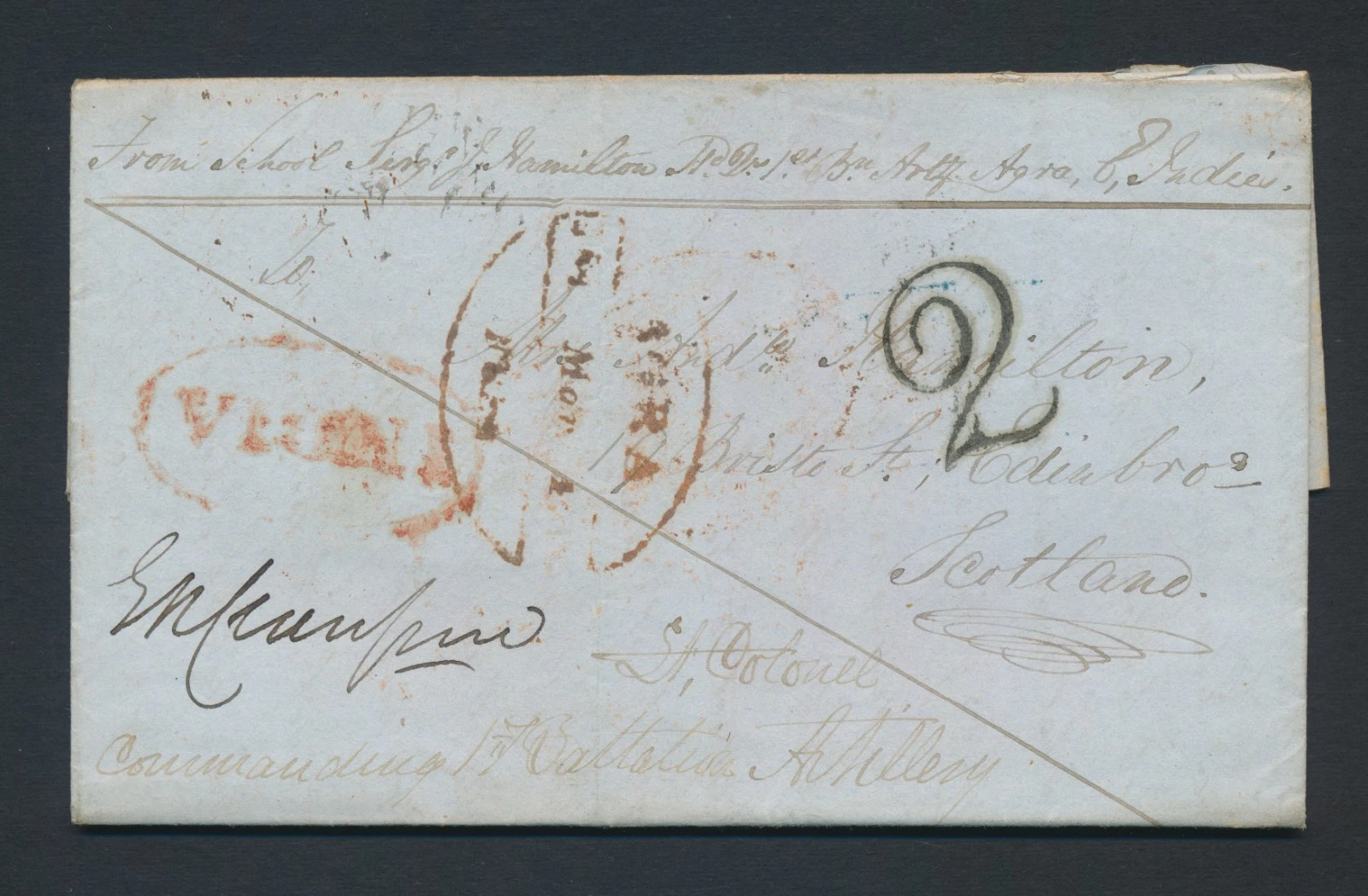
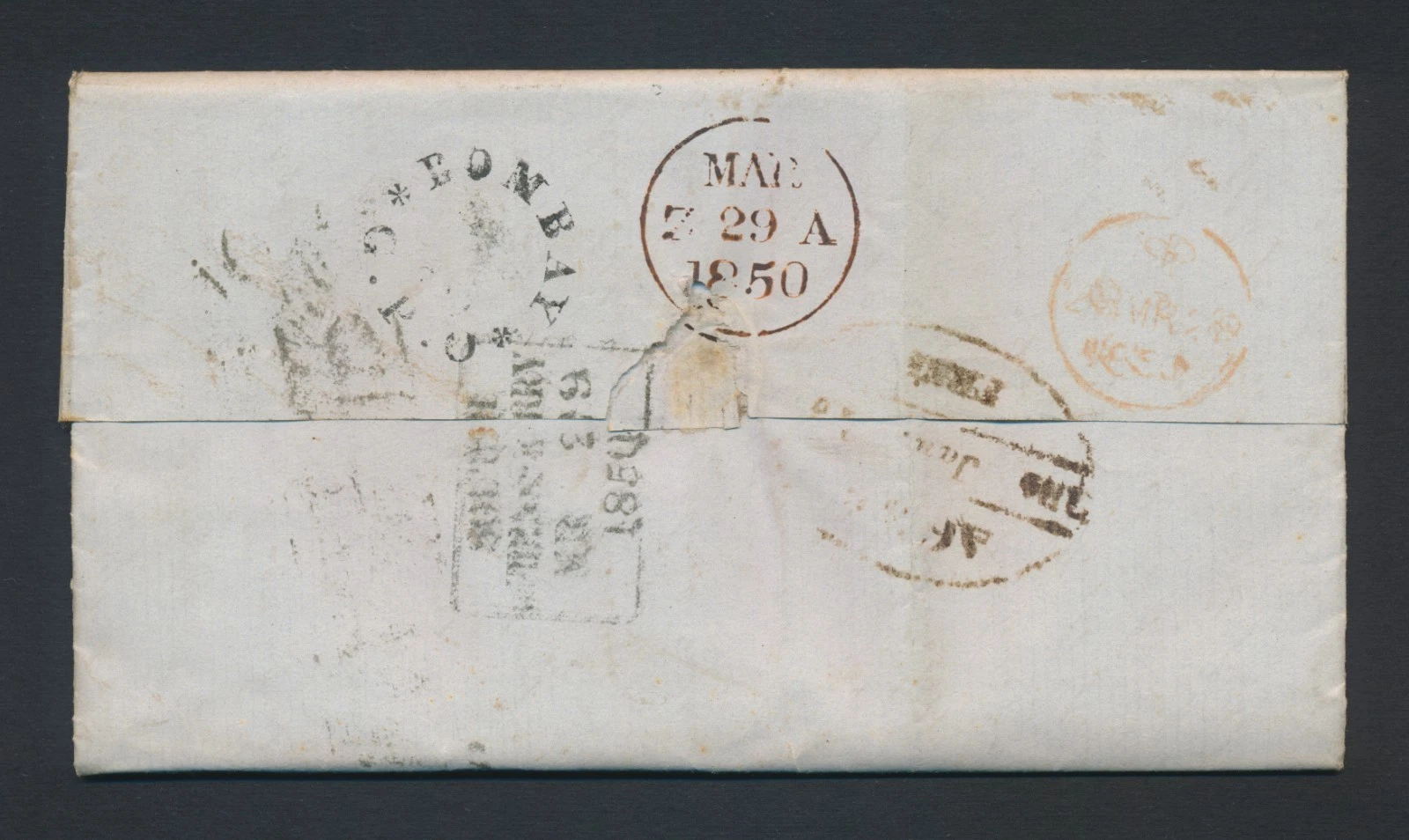
1848 INDIA COVER TO SCOTLAND JOHN HAMILTON ARMY CONCESSION AGRA LETTER SIGNED A beautifully detailed stampless concessionary soldier's letter mailed from the East India Company cantonment at Agra to Edinburgh, Scotland, in the spring of 1848. Continuing the extensive Hamilton family correspondence, this letter focuses entirely on the writer's life as a Military Schoolmaster ("Dominie"), offering a highly unusual, hour-by-hour breakdown of his daily routine. This lot includes the original outer folded wrapper and a 2-page modern typewritten transcription of the original manuscript. Philatelic Identification & Routing: Sender & Authorization: The front panel is endorsed "From School Sergt J Hamilton Hd Qrs 1st Bn Arty Agra, E Indies" and is countersigned by "C. G. R. Crawford, Lieut Colonel / Commanding 1st Battalion Artillery" to authorize the military concessionary rate. Routing & Marks: The cover bears a clear, curved red "INDIA" handstamp and a bold manuscript "2" indicating the 2d concessionary rate. The reverse features a faint red circular Agra dispatch mark alongside two clear receiving/transit datestamps: "APR / G 30 A / 1848" and "EU / AP - 29 / 1848". Address: Addressed to "Mrs Andrew Hamilton, No 19 Bristo St, Edinbro', Scotland". Historical Archival Content (Garrison Life & Raj Luxury): The enclosed transcribed text (dated March 3, 1848) provides an incredible, unvarnished look at the elevated lifestyle an enlisted European could achieve in India: The Daily Routine: Hamilton provides an hour-by-hour schedule of his day: rising at 5 AM to bathe and mend pens, school from 6 to 9 ("teaching, threatening, flogging &c"), learning the native language until noon, and dedicating his afternoons to poetry, geography, and evening parties. Diet & Luxury: He details a diet that would be unimaginably lavish for a working-class Scottish family of the era, noting breakfasts of "ham, beefsteaks, cutlets... eaten by the meanest soldier" and dinners of "different curries... washed down by a bottle or two of best wines". Servants & Status: Despite being an enlisted Sergeant, he casually notes that he keeps four native servants ("a cook, errand boy, bearer/house cleaner, & a syce or horsekeeper") simply to manage his life while teaching 30 scholars. Contrasting Empires: In a striking reversal of typical homesickness, Hamilton explicitly dreads returning home, describing Edinburgh ("Auld Reekie") as "that dirty, filthy hold compared with India". Condition Notes: The original folded wrapper exhibits standard transit wear, minor age-toning, and a manuscript ink smudge on the front panel. The address, countersignature, and postmarks remain legible. Sold with a full 2-page modern typewritten transcription of the internal letter's contents. Sold exactly as photographed. Full Transcription of the Letter Text John Hamilton Agra 3rd March 1848 My dear Mother, How do you get on at all I ask you? and have asked you for months past, but one might as well speak to a door nail as to you in expectation of an answer. Wee Donald, certainly, lets us know pretty regular that you keep well, seem happy & all that, but I think you might condescend to write us yourself. You cannot write - well, are there no lawyer, no penny scribes about Auld Reekie nowadays? Can you not get anybody to write a letter for you for money, love ot whiskey? I would wager my month's pay - and that is five good pounds sterling - that you do not forget the whisky at auld Andrew's on a Saturday night, & yet you forget to let your twa braw, bonny sons, as you sesignate Bob & I, hear that you are still hale & well & unco happy. For myself, dear Mirkie, I am still a Dominie - Gude defend us! - and am likely to be for many years if I behave myself. Which of you ever thought the douce quiet laddie who used of old time to sell pigs & whistles would now be seated in a Schoolmaster's chair, & rear the tawze (sic) over many urchins - even the children of exalted parents -. But it appears I am capable to do it, or I would not have kept such a respectable situation. On looking back on the time since I enlisted it appears short in comparison with the useful knowledge I have acquired from books & the world. I have seen, indeed, I constantly study - in eating - walking - riding, &ccccc - the book is never from me, &, in sleeping, I dream of it all, so you see I deserve an honourable situation like the one I fill. Remember me in your prayers that God may please to increase that knowledge for the good of the children entrusted to my care. Now, since I speak of myself, for I have nothing better to tell you, no news about India at present, did I ever tell you how I was situated since Bob left me. Well then, you must know I am a most regular systematic individual in all my doings. Get up at 5, winter & summer, - bathe, dress, rule out school copies & mend pens &c. then a short walk till 6. - School to 9. - teaching, threatening, flogging &c., "all things by turns, & nothing long" - breakfast - a couple or three eggs, coffee, &c. and learn the country language till 12. Read poetry, write notes, letters, & other business connected with the School till 2. dine, study Geography, compose articles for newspapers, read poetry &c. till 4. Dress again, walk, ride, & drink tea till 6, when I finish the evening with a party, sometimes the theatre, but oftener in my own house, engaged till 8 writing the native language, when I go to Bed. To breakfast I have not only eggs, but a various assortment of all sorts - ham, beefsteaks, cutlets, accompanied by pickles, sauces &c, for these articles of food are very cheap here, & eaten by the meanest soldier. The dinner consists of different curries, fruit in season, & prepared canxisters from England of fish, fowl, meats &c, all wasked down by a bottle or two of best wines. Then a long smoke & commence study. - It is a practice for all parties in this country to sleep after dinner, but I never do this, being of opinion that it brings on the liver complaint & engenders other diseases. I have about 30 scholars at present, and the school is only open from 6 to 9 daily on account of the great heat after that time, so you must think my work is not easy to knock into the heads of 30 urchins so much knowledge on 3 hours. I keep only 4 servants now, a cook, errand boy, bearer/ house cleaner /or , & a syce or horsekeeper, but it is plenty, as/the greatest pest in life /it is to have too many dependents. The following is a sketch of the native language with a translation, " with " the prince asked, "what hast thou done/that fruit?". But 3rd March 1848 - 2 But I am tiring you with all this nonsense. Well, how is Mary Henderson? She never writes us now. How are all your old friends Gibson, Ewings, Paton &cc? bye the bye, did you know if Andrew gave my note to Hood as I never heard. Do you know anything of Bill Foreman, or what he is doing - Andw Brown, I recd Andrew's letter dated 6th Dec 47 (No 7 of Andw jXunr) on the 9th Ult, which I transmitted to Bob. Glad Donald is getting on so well in writing &c - let him study Grammar and spelling a little better. If he was here I would make a man of him, but I expect to see him in a few years with more sense than the majority of persons nowadays. Remember me to old Andrew, Martha &c. I have no letter from them this month. Bob is well and hearty as usual, & doing remarkably well in Lahore. I receive near 50 Rupees (5£) a month from him, which all goes to the funds of the Agra Bank. Bob is a good, honest, kindhearted fellow, and deserves a good wife, and from all appearances that is not likely to occur till we see our flyten, talkative, best of mothers at 19 Bristow St. I am not sure whether we join one another this year or no, , but it is very likely, so we will be separated no more till death, & not before we arrive in Auld Reekie, that dirty, filthy hold compared with India. I beg you will pay particular attention to the postscript, & believe me, my very dear Mother, Yr Affectionate Son, John Hamilton Give the enclosed sheet to Andrew as the 6th I have sent him. From School Sergeant John Hamilton, Hd Qrs, 1st Bn Arty, Agra, E. Indies

Pre-stamp cover of India — Agra HG 13, COV-5708, 1850
COV-5708

1850

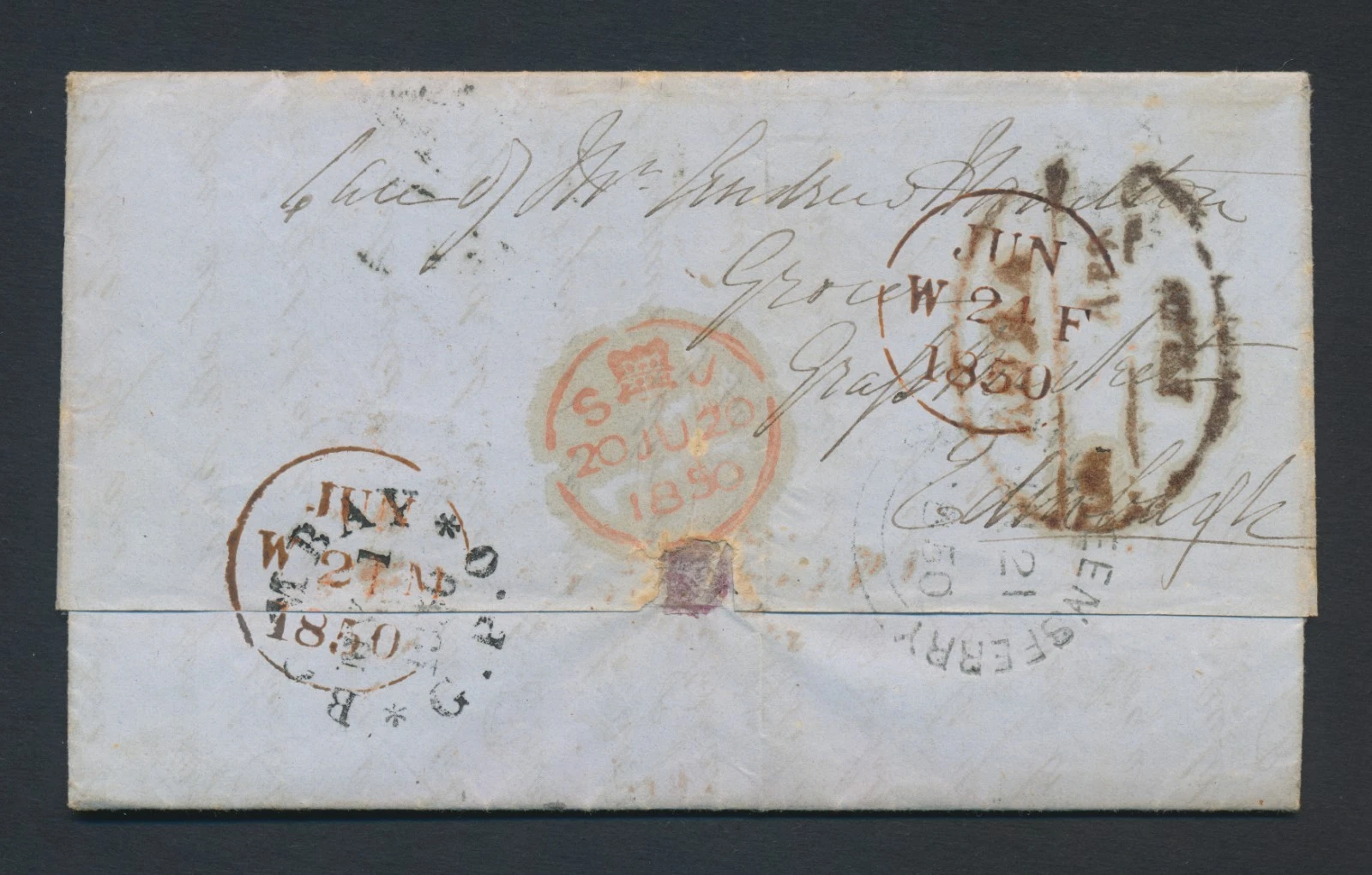
1850 INDIA COVER TO SCOTLAND AGRA ARMY SCHOOL-MASTER CONCESSIONARY LETTER Sender & Authorization: The front panel is endorsed "From Schoolsterg. John Hamilton No 2 Co 1st Bn Arty, Agra E. Indies.". It is countersigned by his commanding officer to authorize the military concession. Routing & Marks: The cover bears a clear, curved red "INDIA" handstamp and a bold manuscript "2" indicating the 2d concessionary rate. Arrival Datestamps: The reverse features multiple clear transit and arrival marks, including a red crowned dispatch/transit datestamp, two Edinburgh receiving circular datestamps ("JUN / W 21 F / 1850" and another from June 1850), and an "S.FERRY" (Queensferry) mark. Re-addressing: Originally addressed to Mrs Margaret Hamilton in South Queensferry, the cover was struck through and readdressed to care of Mr Andrew Hamilton, a grocer in the Grassmarket, Edinburgh. Historical Archival Content (Garrison Life in Agra): The enclosed transcribed text is a brilliant primary source detailing the realities of British cantonment life in India: The Climate: Hamilton opens with a vivid complaint about the Agra weather, stating the heat is so "oppressive" that the "poor Indians are rendered more fit for eating alive by the powerful heat... than to scribble out sheets of nonsense". The Garrison School: He details his new, highly comfortable posting: "I live by myself - away from temptation - delight in my occupation - have a nice school-room, as large almost as the Lancastrian... plenty of scholars - a supply of excellent books to read". Military Pensions: He provides insight into the financial incentives keeping him in India, noting that if he remains a few years longer, he will secure a pension of "2/- a day" alongside some "gowden guineas" to retire with in Edinburgh ("Auld Reekie"). Condition Notes: The outer wrapper exhibits standard age-related toning, transit wear, and ink smudging typical of 19th-century international mail. The manuscript addresses and the red "INDIA" handstamp remain bold and legible. Sold with a full 3-page modern typewritten transcription. Full Transcription of the Letter Text John Hamilton Agra, 16th April 1850 My very dear Mother, The weather is so very oppressive here that you must not expect any long letter from me for some months to come; indeed, without koking, us poor Indians are rendered more fit for eating alive by the powerful heat of the climate at this season than to scribble out sheets of nonsense; and were it not that you are very dear to me, I can assure you the perspiration & fatigue of even handling a pen would keep me from writing. But I love you too well to let a month pass over in solence; and as I remember to have written you a rather harsh epistle in March, I determined to make it up by giving you a letter this month also, though out of your turn, as little Andw. merited this. Well, to begin I was angry with you in my last letter to think you will never write either of us, & since I know you cannot do that by yourself, I have thought it a good plan for you to ask the minister of the Ferry or any other gentleman of old standing in the place whom you know. No gentleman would refuse this favout to a widowed mother; and no gentleman would betray your secrets. We are anxious you should commence such a correspondence to know how you are situated; how certain friends behave to you; how you occupy yourself - for we wish if we knew these & all such matters to better your situation, and make you more comfortable - as we are possessed of the means to do it, and feel sorry that you do not make us acquainted with all the vhit-chat of your mind. Andrew is a good fellow, and tells me all he may think of interest to us; but we want more information, and from your own life. If you neglect to do this, we will employ a solicitor in Edinburgh to come out to you monthly to manage this business. Bob writes me generally twice a month, and his news are always of good health & good conduct & increasing fortune. I have known a great many characters since I left home, but Bob appears to me to be the very best I have had acquaintance with. He is liked by everybody, but I like him best; he is greatly improved in looks - in knowledge - in many other things he was ignorant of in Europe; and my esteem for his manly good sense & honest principle grows greater every day. I regret very much we are separated so long, but neither of us can remedy it, nor do we know when we shall see each other; it cannot be far distant now such a time, as the H. Qrs. I am pretty sure will move from Agra next cold season, & then I might have a chance of joining him. But God orders all these matters for the best, as I have found by experience heretofore. God is a husband to the widow, and a father to the orphan; and at all times, my dear Nother & Andrew, let us trust him - let us pray to Him - in prosperity - in adversity - tho' thousands of miles divide us - yet God is a ready help - present at all times in all lands. I often rejpice that I came to India, for everything here suits my disposition. I live by myself - away from temptation - delight in my occupation - have a nice school-room, as large almost as the Lancastrian (Cuddies') in Davie's Street - plenty of scholars - a supply of excellent books to read. My time is my own out of school, and I spend it mostly in study. I cannot think of giving up so much comfort experienced in such a good situation to come home just yet. Besides if I was to do so I would forfeit all chance of pension; and if I remain here a few years longer, I will be entitled to 2/- a day, which I hope to spend with you yet, my dear Mother, in some snug corner of Auld Reekie, and not only that, but some few hundreds od "gowden guineas" I would fling into your pal when we come home - and will you not be a proud woman then? Do you ever see your old acquaintances in Edinburgh? Take things easy and do not stress yourself at any employment - be of good temper - live well - trouble yourself for nothing - walk about - and do as much good as your circumstances and situation will allow you to do. Be charitable to the poor; and visit the sick, the dying, and those who are in want of consolation. God will bless, and preserve you, my dear Mother, and watch over you at all times. I sent the Remittance on the 1st Inst. so you will get it as usual. Tell Andrew to write us monthly, as we are much interested in his welfare, and would willingly help him if he required it. Give my love to Donald, Bob (your favourite) Martha (old & young) and our respects to anyone who knew us of yore, that enquire after our welfare. Norman has not written me since 1848 and must be dead I think. Poor fellow, I liked him very much, although he did not use me very well at the last. We had a letter from Mary Henderson who is still single. I guess Bob & her will yet buckle - and fancy they will agree very well. But I seldom trouble my head about such things, as I am determined myself to live a bachelor till I land in Auld Reekie when I may take some auld runt "for better for worse" who knew me as a ragman. But whether I ever marry or not you shall always have the first place in the heart, and the first coin in the pocket of - My very dear & good olf Mother - Your most affectionate son, John Hamilton. To Mrs Margt. Hamilton, Terrace, S. Queensferry, Near Edinburgh, Scotland. Cover readdressed: Care of Mr Andrew Hamilton, Grocer, Grassmarket, Edinburgh In Queensferry.

Compare HG 13 across every office →

Submit a cover

Have a cover from Agra HG 13?

Front (and back) image required. It is reviewed before publication — nothing appears immediately.

Images * — front & back (0/3)
Auction house (optional)

Type to search registered auction houses

About this mark

The Agra HG 13 handstamp

Administrative headquarters of Agra District, United Provinces, situated in 27°10' N and 78°5' E, on the right bank of the River Jumna, 843 miles from Calcutta and 839 miles from Bombay. Former residence of the Lodi Kings, and then the Mogul Emperors. Captured from the Marathas in 1803 by Lord Lake, and became the seat of Government when the Presidency of Agra was founded in 1835. Previous to 1835, an ex-territorial Post Office was established in Agra — 1823, or, possibly, earlier. Agra is a city on the banks of the Yamuna in the Indian state of Uttar Pradesh, about 230 km south-east of Delhi. It is best known as the home of the Taj Mahal, and was the capital of the Mughal Empire under several emperors.

Agra HG 13 is a pre-1854 handstruck postal marking of the post office at Agra in the North Western Provinces, British India, in recorded use from 1846 to 1850. Known strikes are in red. It is listed in 1989 Catalogue, where each marking of British India is assigned a figure number — hence "HG 13".

5 surviving covers bearing this mark are recorded in the census, each with images and provenance. On the strength of that count the mark is graded "Common" — the grade moves automatically as new covers are recorded. Collectors searching for agra pre stamp covers, agra postal history or "Agra HG13" material can compare HG 13 across every office or browse the rest of the Agra marks.

"AGRA" close setting

Frequently asked

What is the Agra HG 13 handstamp?
Agra HG 13 is a pre-1854 handstruck postal marking of Agra in the North Western Provinces, British India, in recorded use from 1846 to 1850. The "HG 13" designation is its figure number in the Hammond Giles catalogue of the handstruck postage stamps of India. Known strikes are in red.
How rare is Agra HG 13?
Agra HG 13 is graded "Common" in this census. Rarity here is evidence-based: it is derived from the number of surviving covers actually recorded, not estimated. 5 surviving covers bearing this mark are recorded in the census, each with images and provenance.
What does an Agra pre stamp cover with HG 13 look like?
A pre stamp (pre philatelic) cover from Agra is a folded letter or envelope carried before India's first adhesive stamp of 1854, with postage shown entirely by hand-struck marks like HG 13. 5 surviving covers bearing this mark are recorded in the census, each with images and provenance. Each census record on this page links to full cover images, dates and auction provenance.
How do I identify or submit an Agra HG 13 cover?
Compare your cover against the reference impression and recorded examples on this page — check the mark's shape, colour and date range (1846–1850). If your cover is not already recorded, you can submit front and back photographs through the census form on this page; every submission is editor-reviewed before publication.

Same office

Other recorded marks at Agra

22 marks

22 other pre-1854 postal markings of Agra are recorded in the census. Compare their figure numbers, dates and colours to identify the mark on your cover.

View all Agra marks and postal history →

Suggest a correction

Spotted a wrong date, colour or rarity? Propose a change — every suggestion is reviewed before it is applied.

Also searched as: Agra HG 13, Agra HG13, Agra Giles 13, Agra handstamp, Agra pre stamp cover.

How to cite

“Agra HG 13 — handstamp,” Hand Struck Stamps, https://handstruckstampsindia.com/n-w-provinces/agra/hg-13 (accessed 13 November 2026).

Updated: 13 Nov 2026