
The Forgotten Forwarding Agent
Horatio Hardy & the
Jerusalem Coffee House
Early Anglo-Indian Postal History
Among the many names associated with the development of postal communications between Great Britain and India during the early nineteenth century, few are as intriguing — and yet as little known — as Horatio Hardy. Unlike famous figures such as Thomas Fletcher Waghorn, Hardy was neither a government postal official nor an employee of the East India Company Post Office. Instead, he occupied a unique position within London's commercial world, acting as a private forwarding agent whose influence can still be traced today through some of the rarest surviving pre-adhesive postal covers addressed to India.
His surviving endorsements appear on only a small number of letters, yet they provide valuable evidence of how international correspondence was handled before modern postal systems and regular steam communication transformed global mail. Through his work at the Jerusalem (or East India) Coffee House in Cornhill, London, Horatio Hardy became an important intermediary between merchants, East India Company servants, ship captains, commercial houses, and correspondents scattered across the Indian subcontinent.
Today, signed Horatio Hardy forwarding covers rank among the most desirable items in the field of Anglo-Indian postal history, not only because of their rarity but because they illustrate an important chapter in the evolution of private forwarding services before the establishment of faster and more organized postal routes.
Who Was Horatio Hardy?
The individual commonly referred to in philatelic literature simply as Horatio Hardy was almost certainly Horatio Charles Anthony Hardy, who lived from 1788 to 1850. He inherited responsibility for the celebrated Jerusalem Coffee House following the death of his father, Charles Hardy, in 1810. Charles Hardy himself was already well known in London's East India commercial community, and the family had long-established connections with maritime trade and East India Company shipping.
Horatio married Sarah Ross on 6 December 1821, and throughout the following decades continued operating the Jerusalem Coffee House while simultaneously acting as a commercial forwarding agent for correspondence travelling between Britain and India.
Name variations in trade directories
Trade directory listings
The Jerusalem Coffee House
London's East India Communication Centre
Modern readers often imagine coffee houses simply as places to drink coffee, but during the eighteenth and early nineteenth centuries London's coffee houses functioned as commercial exchanges, shipping offices, news centres, insurance meeting places, and unofficial business headquarters. The Jerusalem Coffee House was among the most important of these establishments.
Situated in Cowper's Court, Cornhill, only a short distance from the Royal Exchange and the East India House, it became one of London's principal gathering places for everyone connected with East India commerce.
By the late eighteenth century it had become widely known as the Jerusalem and East India Coffee House, reflecting its close association with Britain's expanding eastern trade.
- East India Company officials
- Ship captains and managing owners of East Indiamen
- Merchants, marine insurers and underwriters
- Commercial brokers and military officers
- Travellers bound for India
- Individuals awaiting news from Asia
The coffee house also served as one of the earliest centres for shipping intelligence. Long before telegraphs or newspapers could rapidly circulate information, news regarding East India Company vessels, departures, arrivals, delays, shipwrecks, and commercial developments was exchanged here.
From 1780 until 1828, the Society of East India Commanders held its meetings at the Jerusalem Coffee House, demonstrating its importance within London's maritime community.
Hardy as a Private Forwarding Agent
Although Horatio Hardy never held an official appointment within the British Post Office, his surviving correspondence clearly demonstrates that he acted as a private forwarding agent.
Before the development of organized overseas postal services, many letters destined for India did not simply enter the official postal system and travel directly to their destination. Instead, they often followed a much more complicated journey — entrusted to a forwarding agent who would determine the next suitable vessel sailing for India, arrange delivery, and ensure the letter reached the correct commercial contact overseas.
Hardy's combined roles
“The Postmaster General”
“Future correspondence should simply be addressed to Horatio Hardy, Jerusalem Coffee House, Cornhill — he is “the Postmaster General.”
This was not an official title. Rather, it reflected Hardy's practical reputation within London's East India community. Among merchants and travellers he had become so reliable at receiving, forwarding, and distributing correspondence that contemporaries jokingly referred to him as though he were their own private postal administration.
Hardy & East India Company Shipping
Horatio Hardy's expertise extended far beyond simply forwarding letters. His father, Charles Hardy, compiled the celebrated A Register of Ships Employed in the Service of the Honourable the United East India Company. Following his father's death, Horatio revised and substantially expanded this work before its publication in 1811.
The register documented East India Company vessels employed between 1760 and 1810, recording valuable information concerning ships, captains, voyages, and service histories. For philatelists it explains why he became such an effective forwarding agent — few individuals in London possessed greater knowledge of Company vessels, sailing schedules, captains, commercial routes, and arrival and departure patterns.
The Known Timeline
Probable birth of Horatio Charles Anthony Hardy.
Following the death of his father Charles Hardy, Horatio assumed responsibility for the Jerusalem Coffee House.
Publication of the revised East India Company ship register prepared by Horatio Hardy.
A folded entire posted from Calcutta to the Jerusalem Coffee House demonstrates that the establishment had already become an important address for forwarding India correspondence.
Marriage of Horatio Hardy to Sarah Ross.
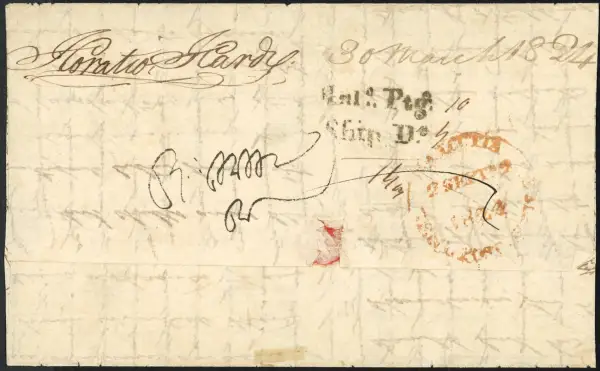
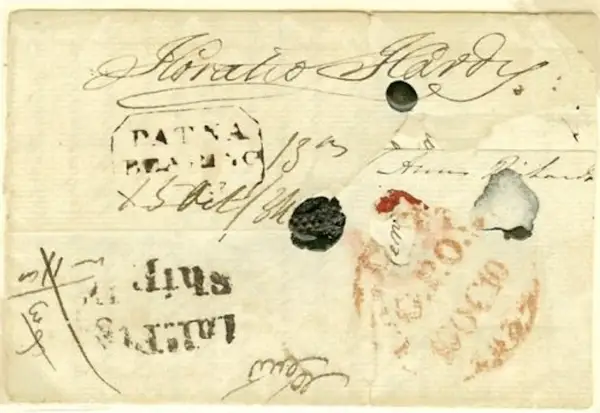
One of the earliest recorded signed forwarding covers bears the manuscript endorsement: “Received & forwarded 7 Feby 1823 Horatio Hardy.” The letter travelled from London to Calcutta before continuing onward into northern India.
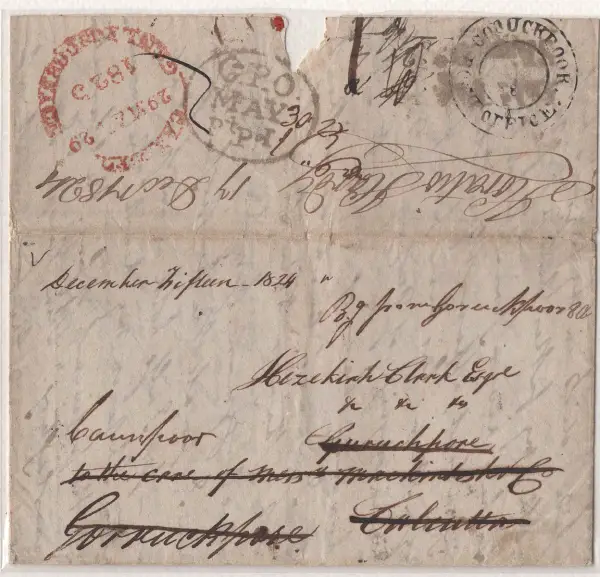
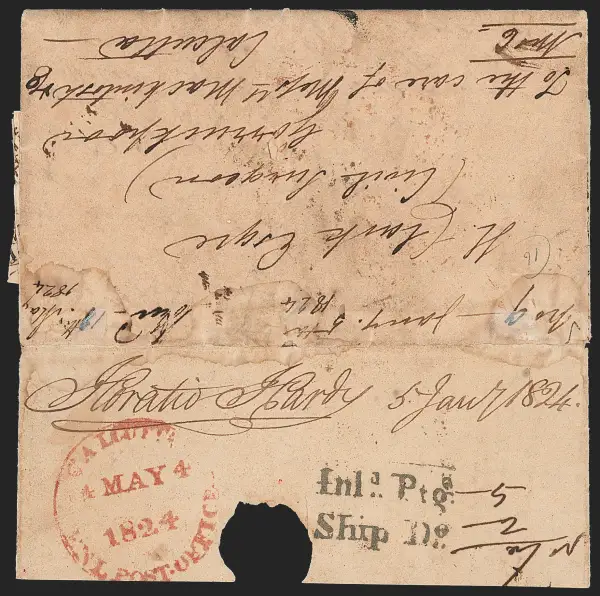
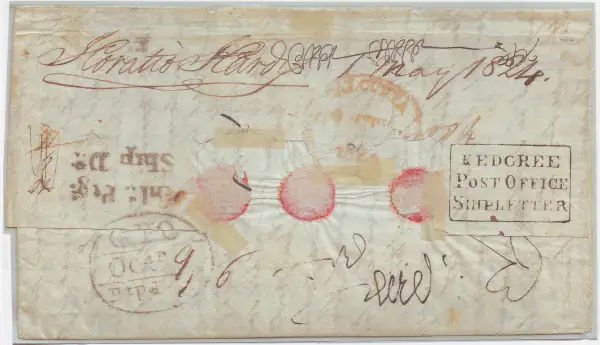
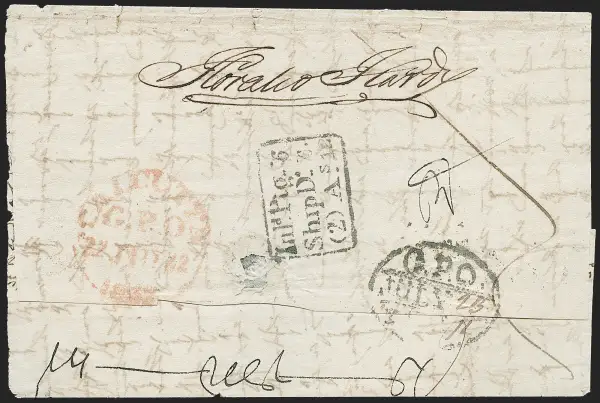
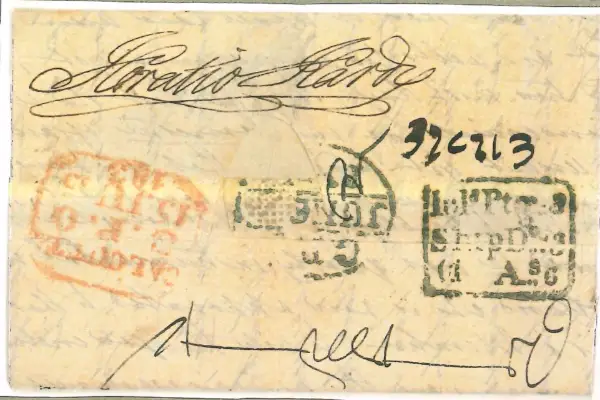
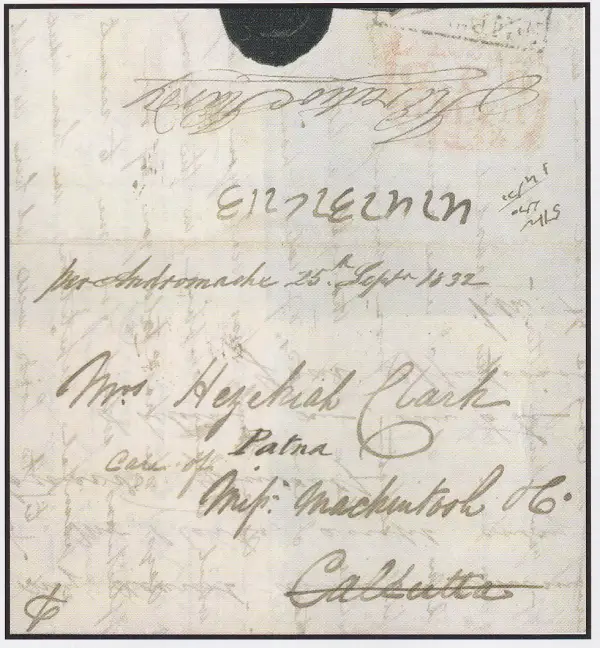
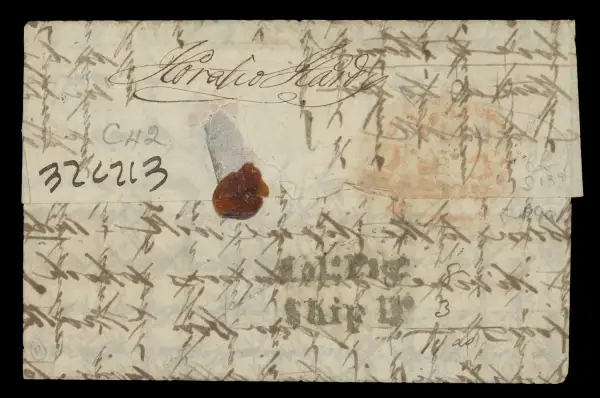
Additional signed Hardy forwarding covers survive from this year. Among the best known are letters addressed to Hezekiah Clark, later redirected inland toward Gorruckpore (Gorakhpur). Several of these covers have realised many thousands of pounds at major philatelic auctions.
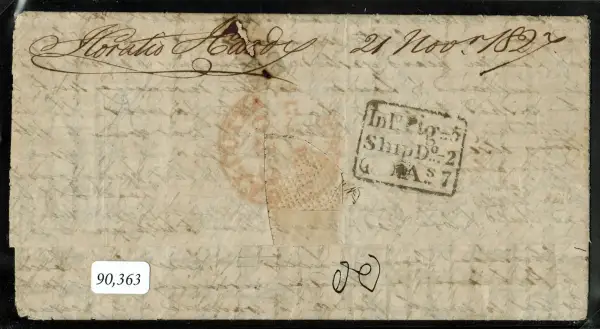
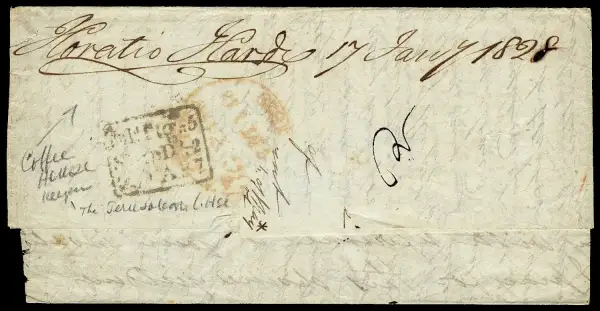
Further signed Hardy correspondence addressed to Hezekiah Clark confirms that his forwarding activities continued throughout the decade.
An amusing but historically valuable incident recorded at the Old Bailey places Hardy walking between the Jerusalem Coffee House and the East India House when he became the victim of a pickpocket — confirming his daily presence within London's East India commercial district.
Correspondence with the famous merchant house Jardine Matheson reveals continuing involvement with Far Eastern commercial affairs. A London Gazette notice also refers to Hardy acting as the trusted custodian of partnership funds pending arbitration.
Following the destruction of the Royal Exchange by fire, Harper & Hardy offered accommodation at the Jerusalem Coffee House for Lloyd's underwriters and arranged for Lloyd's correspondence to be delivered there.
Horatio Hardy appears on the provisional committee of the Medical Philanthropic Society for China and the East, alongside several notable figures connected with Britain, India, and China.
Death of Horatio Charles Anthony Hardy.
Surviving Forwarding Covers
Only a comparatively small number of Horatio Hardy forwarding covers are presently known. Among the most significant recorded examples:
Calcutta to the Jerusalem Coffee House, demonstrating the establishment's role as a forwarding address.
London to Calcutta and onward to Gorruckpore — endorsed: "Received & forwarded 7 Feby 1823 Horatio Hardy." One of the earliest explicitly signed Hardy forwarding letters.
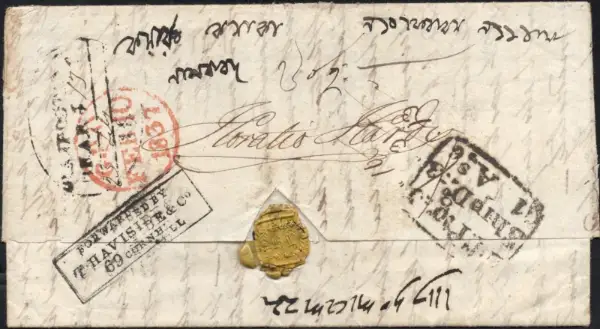
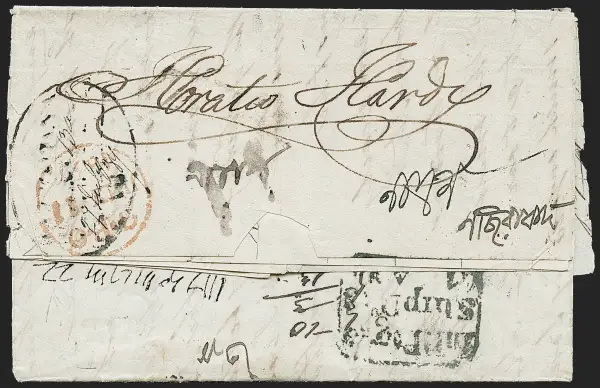
London to Calcutta, redirected inland to Gorruckpore. Signed by Hardy on the upper flap. Certified by the British Philatelic Association — realised approx. £5,500 plus buyer's premium at auction.
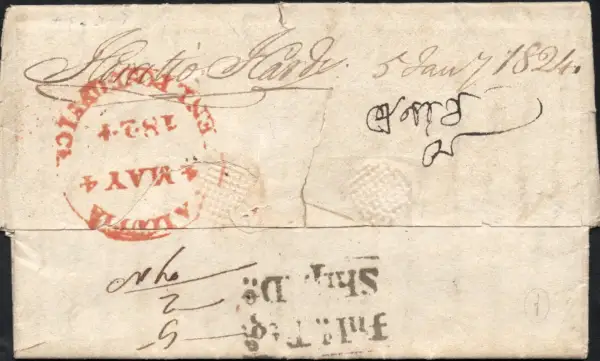
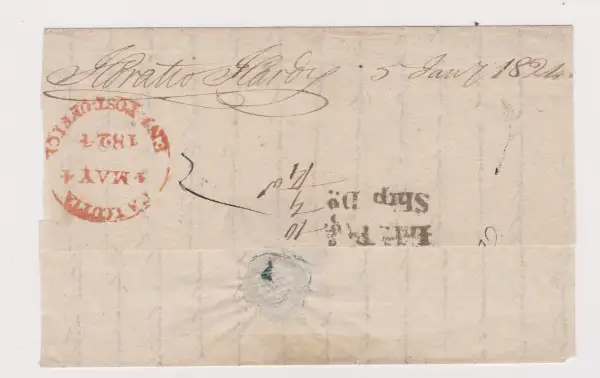
Another important forwarding letter addressed to Hezekiah Clark, signed with Hardy's distinctive flourish. Realised approx. £3,800 at auction.
A further recorded Hardy forwarding entire travelling to Calcutta.
Another surviving Hezekiah Clark correspondence endorsed by Hardy.
Auction catalogues have also recorded additional Hardy forwarding examples dated 1833 and 1837. Perhaps even more remarkable than their rarity is the observation that signed Horatio Hardy forwarding covers appear to be known only for India correspondence. This unique association with Anglo-Indian mail distinguishes Hardy from many contemporary forwarding agents and explains why his letters occupy such an important place within Indian postal history.
Importance to Indian Philately
Horatio Hardy occupies a unique position within the study of early Indian postal history. Unlike official postal markings, his manuscript endorsements document the commercial infrastructure that existed alongside the formal postal system.
The forwarding chain
Although only a limited number of signed Hardy forwarding covers are presently recorded, they provide exceptional evidence for the operation of private forwarding services during the decades immediately preceding the great postal reforms of the nineteenth century. Today they are recognised as some of the finest surviving examples of Anglo-Indian commercial postal history and remain highly prized by collectors of pre-adhesive India.